 Pagember

Website copy should help a visitor understand a service and choose a sensible next step. Rytr offers writing-oriented workflows and a My Voice feature built from a supplied writing sample. That can be useful for a small team that has accurate business information but struggles to turn it into a consistent first draft.

The strongest input is a brief with approved facts and a real example of the brand's writing. This guide follows a hypothetical design studio rewriting its service pages.
Build a factual brief for each page
Write the page's audience, service and action before generating copy. For the example studio, a website-design page should explain who the service fits, what the engagement includes, how the project proceeds and how to request a discussion. A separate maintenance page needs its own scope and expectations.
Supply the details the writer must preserve: service names, delivery responsibilities, supported markets and any approved price statement. Identify claims the business cannot make, such as a guaranteed sales increase. This gives the assistant enough context to be useful without treating a plausible sentence as a fact.
Choose one primary visitor task per page. A paragraph trying to introduce the studio, sell every service and explain the contract at the same time will be difficult to scan. The brief should name what this page helps the reader decide and which supporting detail belongs elsewhere.
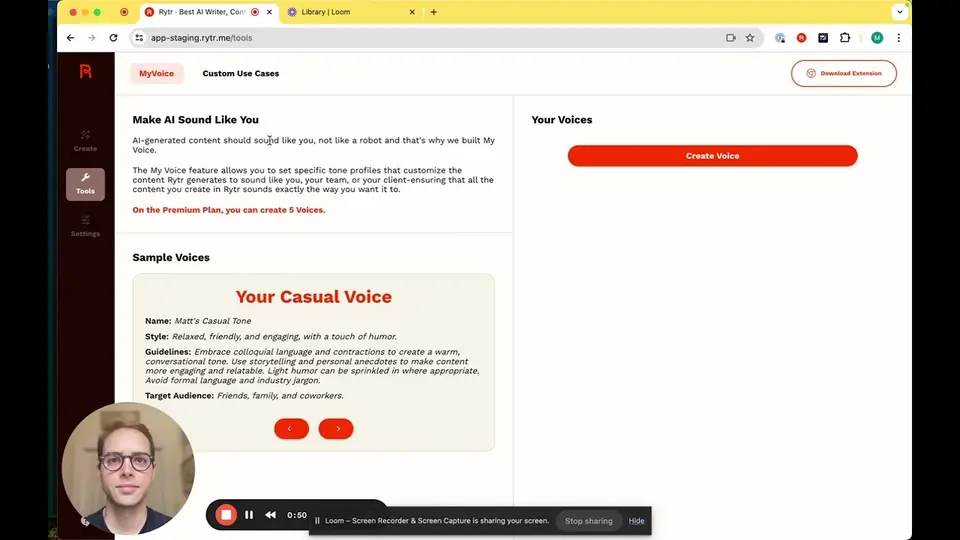 Play video: Using Rytr's MyVoice Feature
Select a voice sample worth repeating
Rytr's My Voice feature uses supplied writing to establish a voice. Choose a sample that reflects the style the business wants to maintain: clear, specific and appropriate for the reader. Do not feed it an old page full of exaggerated claims merely because that page already carries the logo.
For the hypothetical studio, the sample explains a project process in direct language with short paragraphs and concrete actions. It avoids inflated promises and describes responsibilities clearly. That sample gives the team a more useful style reference than a list of abstract adjectives such as bold, innovative and premium.
Keep a small written style note beside the sample. Include preferred terminology, how the business addresses readers and how it writes dates or prices. A generated voice setting helps drafting, while the style note helps human editors make consistent decisions afterwards.
Draft the page in useful sections
Filled brief: a five-page website for an independent shop. In this hypothetical studio, the agreed draft scope is page layout and website build. The shop supplies its approved text and photographs. Hosting, domain registration and migration are quoted separately, and the schedule is agreed after the material and scope are reviewed. The page should lead to a project discussion.
Voice reference: "Tell us what your customers need to find. We will help you organize it into clear pages, then agree the scope before work starts." This is hypothetical sample copy written for the example.
Draft to reject: "Launch in seven days with free hosting and migration, and double your inquiries." Neither the deadline, the included extras nor the result is supported by this brief. A more confident tone would not fix those additions.
Edited headline: "A clear website for your independent shop."
Edited opening and scope: "Help customers find what you sell, when you are open and how to contact you. We plan and build a five-page website around your approved text and photographs. Hosting, your domain and any migration are quoted separately. We agree the scope and schedule with you before work begins."
Edited action: "Discuss your website project." Place it on the actual discussion-request route and explain the next step there; do not label an inquiry form as a confirmed booking.
Edit claims and usefulness before tone
Review the example against the brief before polishing its tone. The edited copy keeps the five-page deliverable, the shop's responsibility for material, separate hosting/domain/migration costs and a schedule that still requires agreement. It makes no claim about a completed site or inquiry growth.
One useful revision request: "Shorten the opening to two sentences. Keep the five-page scope, the client-supplied text and photographs, and the separate hosting, domain and migration quote. Do not add a delivery date or sales promise." Review the shorter result against the same four boundaries.
Then check what a visitor can decide: whether this service fits the job, what they must provide and what the discussion request does. Remove repeated introductions and use the studio's preferred terms consistently. A recognizable voice should make an accurate offer easier to understand.
Use title drafting as an editorial aid
Rytr offers an SEO-title use case. Treat suggested titles as starting points for a clear page label and search snippet, not as a ranking guarantee. The final title should describe the actual service and distinguish the page from other pages on the site.
Keep title, heading and opening paragraph aligned. If the page is about website maintenance, a title promising a complete growth strategy creates the wrong expectation. Check the actual preview in the website's content system so the published title and description reflect the final copy. The guide to search titles and meta descriptions covers length and wording.
Avoid stuffing several service variations into one sentence merely because they seem like search terms. Readers need a coherent explanation. A page can use the language its customers use while still sounding like a helpful business rather than a keyword list.
Choose the plan around volume, voices and language
Rytr’s public pricing rechecked on October 18, 2026 uses Free, Lite, Personal and Pro. The older Unlimited and Premium references no longer describe the current lineup. For website copy, evaluate the writing workflow and character allowance rather than an old plan’s voice or language count.
Lite removes the character limit. Personal and Pro expand connected context and Engage usage for broader communication work. These additions do not automatically make a website paragraph better. Choose around the drafts and revisions the team actually finishes.
For the example studio, assess the finished page: accurate scope, a recognizable voice and a clear next step. Verify that the current account exposes the required writing and voice controls, then evaluate one complete page before extending the subscription commitment.
Review the final page in the real design
Paste the approved copy into the actual website and inspect mobile and desktop. A heading that reads well in a document can wrap awkwardly in a narrow card. Check button labels, paragraph width, spacing and the relationship between copy and supporting images. For later edits to a single paragraph on the live page, the Rytr browser extension guide shows how to rewrite one passage without touching the rest.
Rytr is a useful candidate for repeated short-form drafting when the business supplies a solid brief and maintains an editorial voice. The result should be a site where each page has a clear purpose, service statements stay accurate and the next step feels straightforward. Count the finished pages you publish. Before publishing, run each page through the AI writing fact-check workflow, and see the Rytr company guide for plans and features.