 Pagember

AI can help turn a verified product record into readable copy, but it should not decide what the product can do. Supply approved facts, forbid unsupported additions, and compare every objective claim with the source before publication. Review each variant separately where materials, dimensions or included parts differ.
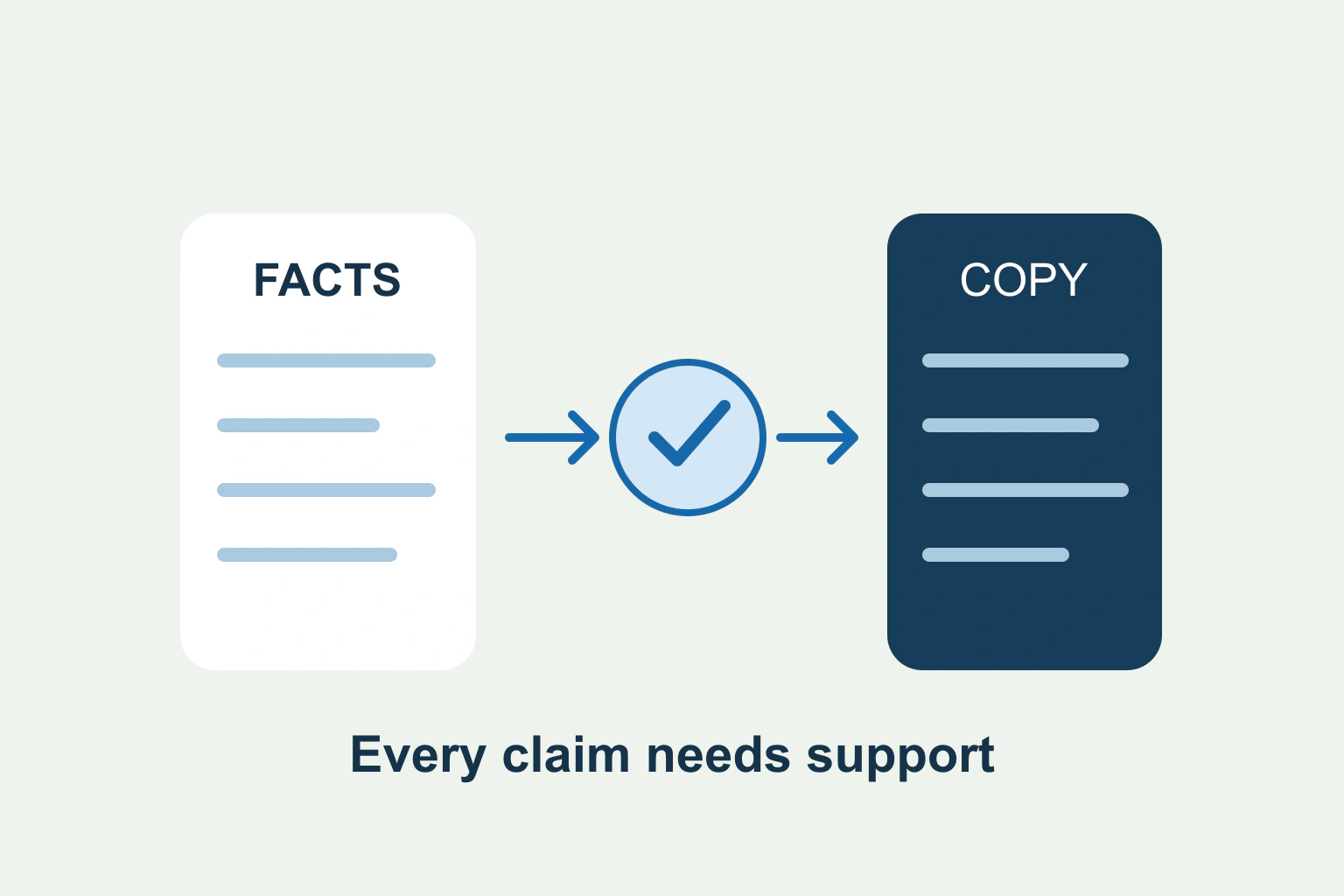
A fluent paragraph is not evidence. The useful workflow starts with the item the customer will receive and ends with a reviewed description tied to that item.
Build the product record first
Collect the manufacturer's current specification, your own verified product information and the exact variant identifier. Separate measurements, materials, compatibility, included components, care instructions and exclusions. Keep the source date and the person responsible for confirming changes.
Resolve contradictions before drafting. If packaging says one capacity and a supplier spreadsheet says another, do not ask the model to choose the more plausible figure. Mark the field unresolved and request clarification. A missing detail is safer than an attractive but unsupported addition.
The NIST Generative AI Profile identifies confidently false output as a risk. The consequence for product copy is straightforward: model confidence cannot replace evidence about the actual item.
Distinguish a fact from its suggested benefit
A verified feature can support a careful explanation, but the connection needs review. A bag with an internal divider can help separate items; it does not automatically protect a laptop from impact. A listed material does not establish an environmental certification, and a connector shape does not prove compatibility with every device.
| Draft statement | Evidence needed | Decision |
|---|---|---|
| Includes an internal divider | Verified construction or specification | Use when true for this variant |
| Protects laptops from drops | Relevant supported protection claim | Remove if unsupported |
| Suitable for every laptop | Dimensions and compatibility evidence | Replace with precise fit guidance |
| Certified sustainable | Applicable current certification | Do not infer from material wording |
Give the reviewer a simple classification: verified fact, reasonable explanation, claim needing specialist support, or unsupported text. This makes review more useful than asking whether the draft “sounds right”. Benefits deserve the same attention as numbers.
Write a bounded drafting brief
Tell the model who the buyer is, which placement the copy serves and which facts it may use. Request a description that preserves units, variant identity and qualifications. Ask it to list unresolved fields separately rather than fill them with assumptions or include internal notes in customer-facing copy.
A brief you can paste above the product record:
Use only the supplied product record. Do not add certifications, compatibility, durability or performance claims. Keep unknown fields out of the description. Write about 50 words for the product page in plain British English. Return a separate list of statements that need confirmation.
Models do not always follow a brief, so the review step below still applies to every draft.
Keep private supplier terms, customer records and unreleased commercial information out of an unapproved service. Review the tool's data settings and your authority to share the source material. A product description task rarely requires an export containing every internal purchasing field.
A worked review of a hypothetical backpack
Invented product and source record: the facts and copy below are a teaching example, not a real product listing. The mock record is variant BAG-20-A, version 1.
| Approved field | Value allowed in the copy | What remains unconfirmed |
|---|---|---|
| Capacity and construction | 20 liters; polyester outer fabric; zip closure. | Water resistance, fabric certification and durability testing. |
| Organization | One divider in the main compartment, creating two sections. | Padding, impact protection and compartment dimensions. |
| Pack quantity | One bag. | Accessories, laptop fit and airline size acceptance. |
Reject this embellished draft: “This waterproof, airline-approved backpack protects every 16-inch laptop and is made from certified sustainable fabric.” None of the four promises is supported by the mock record. Remove them; do not soften them to “ideal for” or “designed to protect” while leaving the same unsupported impression.
Finished factual description (45 words): “This 20-liter bag has a polyester outer fabric and a zip closure. One internal divider creates two sections in the main compartment. The pack contains one bag. Confirm the compartment dimensions before choosing it for a laptop or another item that needs a precise fit.”
Reviewer’s unresolved list: request compartment dimensions for fit guidance; request relevant evidence before any water-resistance, protection or certification claim; check the intended airline’s current rules before discussing cabin use. Unknown does not mean the feature is absent. It means the supplied record cannot support the claim.
The internal note about unknowns stays with the review record. The customer-facing page still needs any material fit information or warnings confirmed before it is offered as a suitable laptop bag. For a different variant, repeat the check instead of copying the approved description automatically.
Drafting tools that fit this workflow
A general writing assistant works for this job as long as you can paste the record and the brief and keep the output short. Rytr lets you save a brand voice and reuse it across descriptions; the Rytr website copy workflow shows how to set that up from approved copy. Writesonic is another option for larger catalogs. Whichever you use, the product record stays the source of truth and the reviewer signs off each variant.
Review claims in the market where you sell
The FTC's advertising overview requires truthful, evidence-based, non-deceptive claims in its jurisdiction. AI assistance does not change the publisher's need to support the claims it chooses to display. Other markets and specialized products have their own requirements.
Escalate health, safety, financial, environmental or regulated claims to the person qualified to approve them. Do not let an ordinary copy review silently become that approval. Where the product needs warnings or limitations, preserve them in a meaningful place rather than deleting them to make the copy more persuasive.
Also check the combined impression of title, photographs, badges and description. A cautious paragraph can still sit beside an unsupported certification icon or image that implies an included accessory. Review the customer-facing page as one offer.
Keep website copy and product feeds consistent
Map approved facts to the fields your store and sales channels actually use. A rewritten description should not change SKU identity, variant attributes or the included quantity. Preview a parent product and a specific variant to ensure a shared paragraph does not describe features belonging only to another version.
Google Merchant Center's description reference specifies the structured-description attribute for descriptions created using generative AI. Follow the current destination's data requirements; a correct paragraph can still be submitted in the wrong field. If a listing is rejected after an update, the Merchant Center disapproval guide helps find the mismatch.
Do not assume updating the store changes every connected channel immediately. Inspect the resulting feed or destination record through its supported workflow. Keep the approved source record so a later discrepancy can be traced to copy, integration or an outdated catalog value.
Approve the delivered page, not just the document
Read the final title, description, specifications, selected variant and cart line together. Check units, decimal separators and translated wording. Review the page on a phone so warnings, included quantities and important qualifiers remain visible beside the claims they qualify.
Record who approved the copy and which source version it used. Trigger review when the supplier changes the item, when a variant is added or when a claim is challenged. Reusing a paragraph should never mean assuming that every product in the category has the same properties.
Start with a small, varied sample of products before expanding the process. Include incomplete records and similar variants, because those are the cases most likely to reveal weak controls. Measure correction types and review effort; do not treat the volume of generated text as a measure of catalog quality.
Continue with the relevant checks
Fact-check any AI-assisted draft before publishing. Choose an AI tool by its practical task and controls. Check permissions for the images accompanying the copy. Keep the published language accurately declared.