 Pagember

Within ElevenCreative, ElevenLabs Speech to Text gives a website publisher a practical starting point for turning an interview into readable text. An editable draft is useful because readers can revisit a particular answer without replaying the whole conversation. The strongest result combines that convenience with careful checking of what was said and who said it.
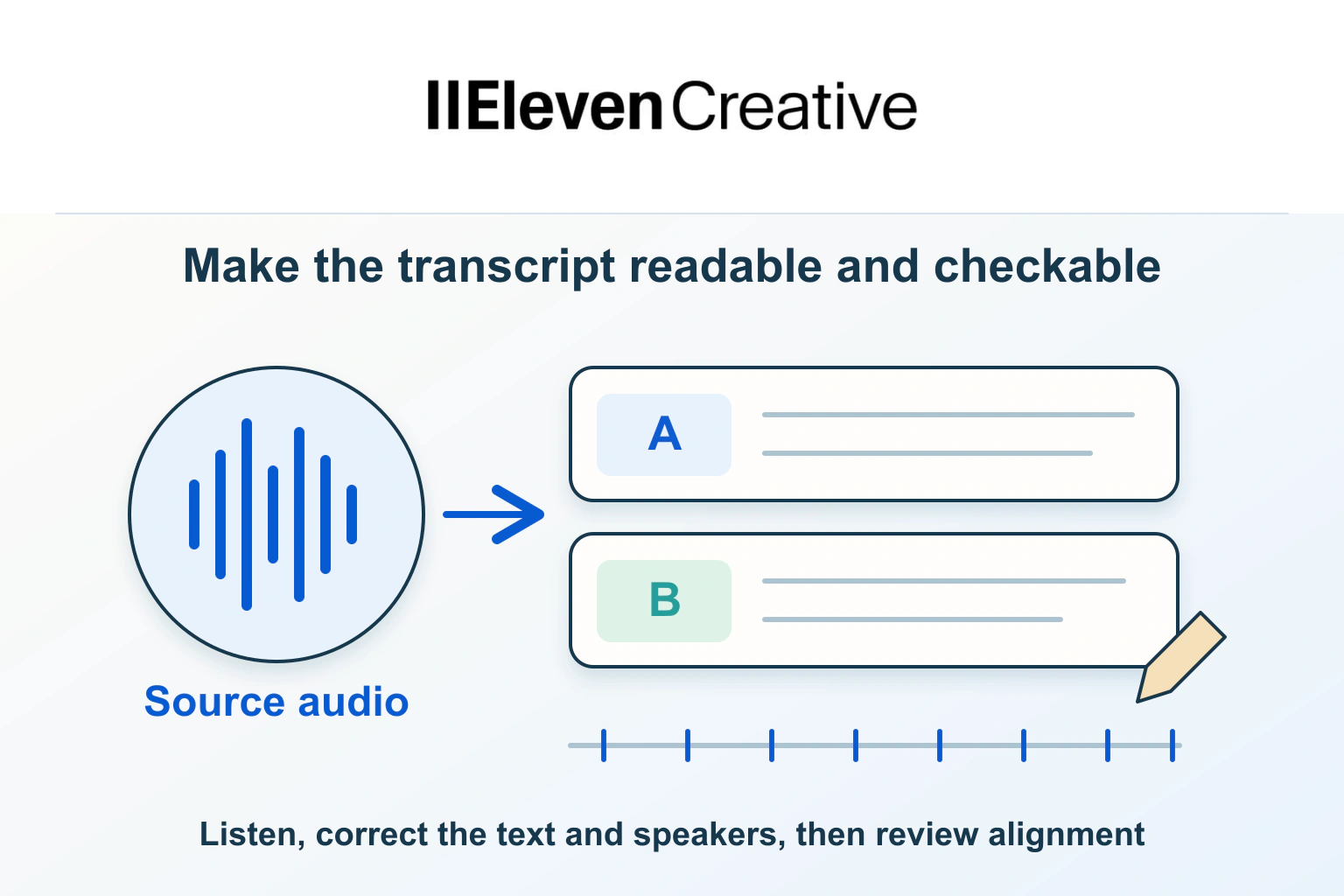
Imagine an interview between a site editor and a community organizer about a new resource directory. The publisher wants an accessible reading version beside the recording, with clear speaker labels and meaningful sections. The workflow below focuses on transcription and manual review, rather than generating a new voiceover or rewriting the interview into different claims.
Agree what the published transcript should represent
Decide whether the page will contain a close transcription or a lightly edited reading version. Tell readers when repetition or verbal fillers have been removed. A summary is a different editorial product and should not be presented as a complete record of the conversation.
Keep the original recording unchanged and record its date, participants and intended publication scope. Confirm the necessary permission to process and publish the interview before uploading it. An agreement to join a conversation should not be treated automatically as permission to publish every personal detail mentioned during it.
For the hypothetical directory, mark sections that may need the organizer’s confirmation, such as a quoted launch date or a named community group. Keep these as open editorial checks. A clear working list is more useful than silently guessing an unfamiliar name and letting that guess become the public version.
Create the first draft and listen to the important passages
The ElevenLabs Speech to Text guide describes uploading audio or video from the dashboard’s Transcribe files control. You can choose a known language or automatic detection and select audio-event tagging. In the results, clicking a word starts playback at that point. Speakers can also be renamed.
Begin with a short, permitted sample from the interview before processing the complete publication workflow. Listen to ordinary speech, an unfamiliar name and a passage where the speakers overlap or change quickly. Keep observations specific to that recording, rather than treating a promising sample as an accuracy guarantee.
Read once for overall meaning before polishing individual sentences. Does the draft preserve the question and answer? Did a hesitation become an unintended certainty? Are a date and its qualifier still together?
Correct meaning before improving readability
The ElevenLabs Transcript Editor supports direct text editing, segment timing changes and splitting or merging segments. Adjacent segments can be merged when they belong to the same speaker. After changing a segment, its Align words control recomputes word-level timing. The editor also supports reassigning segments to speakers and exporting text, HTML, JSON, SRT or VTT.
For the interview, correct names, quantities and negation first. “We cannot accept submissions yet” must not become an invitation to submit. If the audio is uncertain, replay the surrounding passage and ask for clarification where needed. Do not replace an unclear phrase with a more persuasive claim merely because it reads smoothly.
Keep a simple correction log for consequential changes: time in the recording, original draft wording, reviewed wording and the reason. Small punctuation changes may not need an elaborate record; a changed deadline, person’s name or statement of eligibility deserves one. This helps a second reviewer focus on the decisions that matter.
Check speaker identity instead of trusting a label
Automatic speaker separation is a useful draft structure, but a label is not independent proof of someone’s identity. Listen to the introductions and subsequent exchanges before assigning public names. Use consistent labels such as Editor and Organizer when full names are unnecessary or outside the publication agreement.
The transcript editor offers individual and bulk speaker reassignment. Its documentation warns that deleting a speaker also deletes associated segments. Review the affected speech before a broad change, so an attempt to tidy the speaker list does not remove part of the interview.
In the directory example, check a brief interruption separately from the main answer. A short “yes” can belong to the interviewer even when it appears beside a long response. Keep the attribution tied to the audio, and preserve an unresolved label visibly in the working draft until someone can verify it.
| Publication element | Review against the recording | Acceptance note |
|---|---|---|
| Names and specialist terms | Listen and confirm spelling where needed | No unresolved guess is published as fact |
| Dates, numbers and negation | Check the complete statement | Qualifiers retain their meaning |
| Speaker labels | Verify turns and brief interruptions | Attribution is consistent |
| Sections and timestamps | Review the intended passage boundary | Readers reach the relevant discussion |
Give the transcript a useful website structure
Choose a reading format that suits the page. A continuous interview can benefit from topic headings, consistent speaker labels and a short explanation of the recording. Keep headings descriptive without putting words in the interviewee’s mouth. An editor’s section title should remain distinct from a quoted answer.
After exporting, review the actual text inserted into the website. Check special characters, paragraph boundaries and the sequence of speakers. Check that the published page displays the whole interview. Compare the beginning, a middle exchange and the ending against the reviewed working copy.
If the project later needs spoken narration for a separate article, the ElevenLabs narration workflow covers that different direction of work. Here, the recording remains the reference for the transcript rather than being regenerated from edited text.
Budget for the transcription you need
Check the recording duration, current Speech to Text usage rate and required export before choosing a plan. A speech-generation minute estimate is not a transcription quote. The transcript editor provides correction and export controls; the recording remains the reference for meaning and speakers. Include any separate human transcription service in that budget if you choose one.
Review subtitles as a separate publication version
ElevenLabs documents transcripts and subtitles as separate editor outputs. Changing one does not change the other. Subtitle mode has its own text, cue timings and formatting rules, with SRT and VTT export. Do not assume a transcript correction automatically repairs a subtitle file already prepared for the video.
Keep a release checklist for both versions when the interview page includes subtitles. Compare the corrected names and consequential statements in each. Confirm that subtitles are readable in the actual player, while the reading transcript remains understandable on its own. Different formatting is expected; contradictory wording is not.
For a multilingual edition, the ElevenLabs multilingual-content guide covers a separate editorial review. A speech transcript should not be silently treated as a reviewed translation or a new-language voiceover.
Publish a checked reading experience
Preview the real page on a phone and a larger screen. Read speaker labels in order, follow any supplied timestamp links and check that headings help readers navigate. Confirm that any redactions are applied consistently across the page, downloadable transcript and subtitle version intended for release. The guide to audio players and transcript delivery covers placing both on the page, and the podcast show notes workflow reuses the reviewed transcript for chapters and quotes.
The ElevenLabs pronunciation guide concerns preparing generated speech, rather than correcting this transcription. Keeping those workflows distinct makes it easier to choose the right tool for the job.
ElevenLabs is appealing here because transcription, review controls and export can form one deliberate preparation process. Use the draft to make editorial work more manageable, then let the recording and publication agreement govern the result. Plans and the other ElevenLabs workflows are in the ElevenLabs company guide.
ElevenLabs and the ElevenLabs logo are registered trademarks or trademarks of ElevenLabs, Inc. Used with permission. Brand and affiliate terms.