 Pagember

Multilingual audio can help a business explain the same service to readers in different markets. ElevenLabs offers text-to-speech models with different language coverage and generation characteristics. The useful project is a maintained set of localized assets that say the right thing for each audience, built one market at a time.
This guide follows a hypothetical education company localizing a short course introduction, with a language reviewer for each market. The workflow keeps scripts, voices, rights and revisions connected.
Choose markets before choosing voices
Start with the audiences the business actually serves. Identify the language, local terminology and destination page for each version. A course introduction aimed at one market may need different contact details, dates or examples from another, even when the core lesson is the same.
For the hypothetical education company, the first release covers two established markets. It has a reviewer for each language and a current landing page for each version. This is more practical than generating a long list of languages without anyone responsible for checking or updating them.
Write the deliverable for each market: audio only, a narrated video or a page with an audio option and transcript. Decide whether the business needs matching timing across versions. A translated script can take a different amount of time to speak, so identical visual timing should be a production requirement to investigate rather than an assumption.
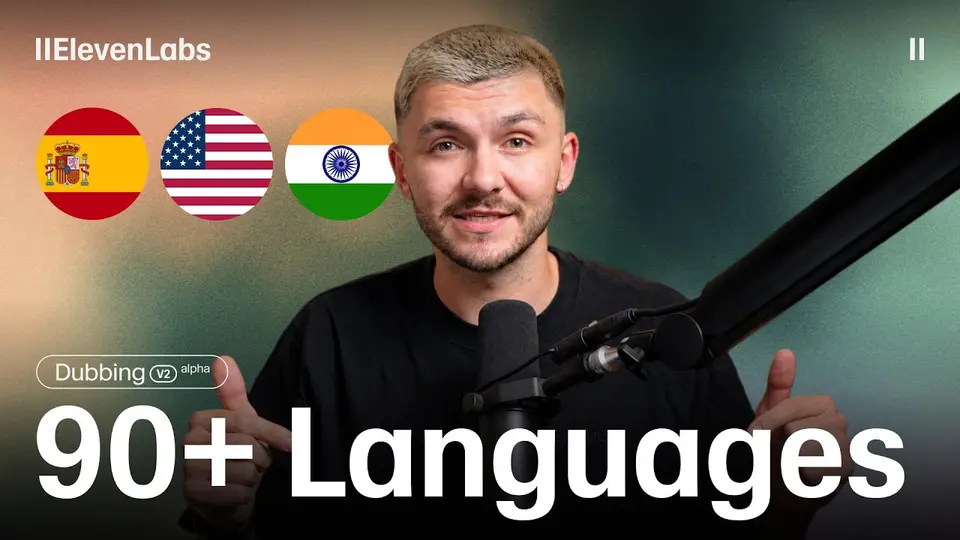 Play video: Translate your Video to 90+ Languages Using Dubbing v2
Approve the source script before translation
Make the original message concise and factual. Remove idioms that do not travel well, define product terms and separate permanent information from a temporary offer. The more stable the source script, the less repeated localization work the team creates later.
Record which phrases must remain consistent, such as a course name or a specific technical term. Give the translator context about the audience and the action the listener should take. A literal sentence can be grammatically correct while sounding unnatural or pointing the reader to the wrong local process.
Keep the source script version attached to every translated version. When a lesson changes, the editor can identify which language files depend on the old wording. This is a content-management task that generation alone cannot solve.
Check language support for the chosen model
Language coverage depends on the model. The ElevenLabs models page lists Eleven v4 and v4 Turbo at more than 90 languages, Eleven v3 at more than 70, Multilingual v2 at 29 and Flash v2.5 at 32, while Flash v2 is English only. Pick the model from that table for each target language, then confirm the voice you want works with it.
Use a short sample containing the difficult parts: product names, numbers, local abbreviations and a meaningful pause. Have a qualified reviewer assess meaning, pronunciation and appropriateness for the audience. A fluent-sounding voice is not proof that the instruction has retained its intended meaning.
| Localization element | Owner | Acceptance question |
|---|---|---|
| Translated script | Language editor | Does the meaning fit this market? |
| Voice and pronunciation | Audio reviewer | Are terms and delivery understandable? |
| Destination and offer | Market owner | Does the action lead to the correct local page? |
Save the approved terminology with the project. That glossary can make future scripts more consistent, while the human reviewer still checks each final asset in context. Do not assume that one correct sample establishes perfect pronunciation for every future sentence. For recurring names and acronyms, a pronunciation dictionary keeps the approved form in one place for each language.
Review voice, script and destination together
Listen to each localized version against its approved script. Check that the audio has not omitted a condition, changed a number or introduced an awkward transition. Review captions and transcripts as well if the deliverable includes them.
Then follow the action from the actual page or video description. A localized introduction should lead to the correct market's course details, currency and contact process where those differ. A polished voiceover that sends every listener to an unrelated language page leaves the user journey unfinished.
If several versions share visuals, inspect text wrapping and timing in each one. A longer translated label can overflow a card even when the source version looks balanced. Keep text editable and allow the layout enough room rather than shrinking every translation to fit a fixed image.
Budget the shared credits for revisions
The ElevenLabs pricing page checked on November 21, 2026 listed standard monthly prices of US$6 for Starter, US$22 for Creator and US$99 for Pro, with 30,000, 121,000 and 600,000 credits respectively. Free lists 10,000 credits. The order summary shows the plan, credits, tax and renewal before you pay.
Credits are a shared allowance across products, with model-dependent consumption. Estimate the work from representative samples, including multiple languages, corrections and discarded takes. A ten-minute final library can require more generated material when editors revise scripts or try alternate delivery.
Keep a simple production log with the script version, target language, chosen model and approved output. Review actual consumption after the first project before moving to a longer billing commitment or expanding to more markets. The useful unit is a finished localized asset the business can publish and maintain.
A small version budget before expanding
Here is an original planning example, not a usage test: six source sections in two target languages require twelve section outputs before retakes. If four sections need another take, the plan contains sixteen generation tasks. Credit cost still depends on the chosen model and operation. Measure one representative sample, then compare the actual allowance with that workload. A maintained language library is a clearer upgrade reason than a promise of better audio.
Use the right commercial and voice permissions
Free output does not include a commercial license. Eligible output generated on paid plans can be used commercially subject to the provider's terms, content rights and feature-specific restrictions. Earlier Free output does not become commercially licensed merely because the account later upgrades. Beta Services have separate noncommercial and production restrictions in the official guidance.
Rights to a translation, script, music track or person's voice remain relevant. If using a real person's voice, establish authorization for the intended markets and future reuse through the provider's permitted workflow. A localization project should not imply endorsement by a speaker who did not authorize it.
Maintain a small, dependable language library
Publish the approved versions with transcripts and clear language selection. The checklist for reviewing AI website translations covers the page text around the audio. Keep a list of where each file is used. When the course or offer changes, update the source script, route the affected translations for review and replace the related audio deliberately.
ElevenLabs is a relevant option for this production job when the business can pair generation with language ownership and a clear rights process. Begin with markets the company can support well. The ElevenLabs company guide summarizes plans and features, and the AI voiceover guides cover scripts, narration and voice rights in more depth.
ElevenLabs and the ElevenLabs logo are registered trademarks or trademarks of ElevenLabs, Inc. Used with permission. Brand and affiliate terms.
