
Combine historical snapshots, current safety observations and registration context. No single clean lookup proves a domain has no prior abuse or guarantees search performance.
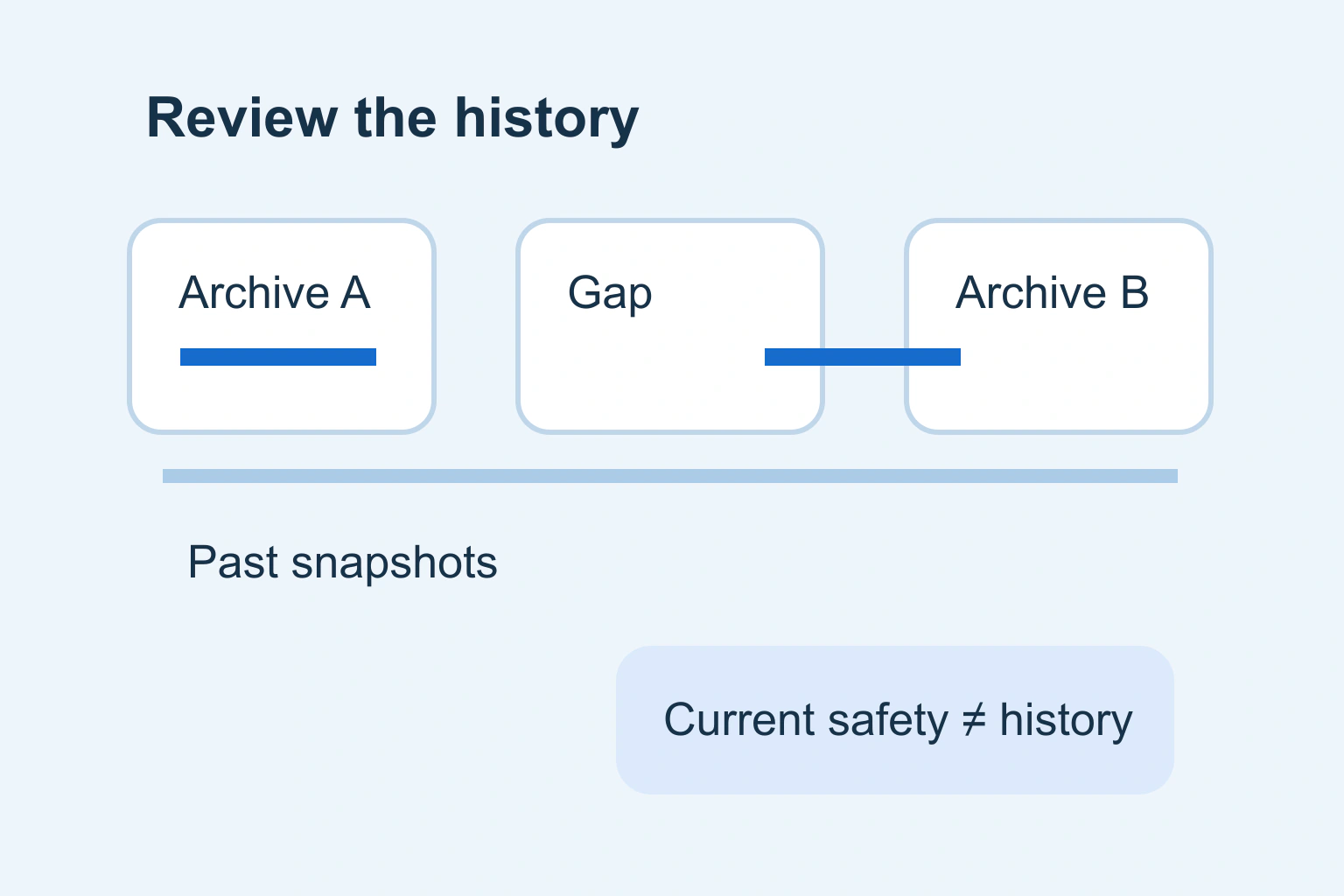
Check a used domain through several independent views, and record what each view cannot establish. Archived pages can reveal previous content. A current safety report can flag known present threats. Registration information can identify the current registrar and status. None is a complete historical guarantee or a promise that a new website will rank.
A fictional community workshop considers acquiring a short domain previously used by another organization. The examples below are an evaluation framework, not a finding about a real domain. Complete the assessment before committing money, importing old files or presenting the name as your own.
Define why the domain is useful to the new business
Write the operational reason first: memorable communication, a legitimate brand match or continuity in an authorized acquisition. If the entire proposition depends on an unexplained “authority score,” require a clearer business case. Third-party metrics do not establish that a domain’s former reputation will transfer into useful visibility for unrelated content.
Describe what is included in the acquisition. A domain registration, website content, customer data, trademarks and social accounts are different assets. Buying a domain does not inherently give permission to republish photographs, assume a former organization’s identity or contact its customers.
Set a maximum acceptable cost and identify unresolved conditions that would stop the purchase. A process is more useful when the decision criteria exist before a persuasive seller’s presentation. Keep the domain spelling, extension and relevant listing identity precise throughout the review.
Inspect several periods of archived use
The Internet Archive’s Wayback guidance explains that coverage can be incomplete and that archived navigation may cross dates or reach live material. Inspect representative periods rather than treating one attractive homepage snapshot as the whole history.
Look for changes in subject, organization, language and purpose. A long-running workshop followed by a sudden unrelated gambling site is different from an ordinary redesign. Note what you actually saw, with capture dates and specific pages. Do not label missing captures as evidence that nothing happened.
Review more than the homepage when material is available: contact pages, product sections and important paths can reveal a different story. Avoid interacting with archived login or purchase forms. Historical content is evidence to evaluate, not an instruction to enter credentials or download unknown software.
Separate current safety from historical completeness
Google’s Safe Browsing FAQ describes detection of unsafe content. A present warning is a reason for investigation. No warning, or no available information, is not proof that the domain has never been compromised, used for spam or affected by other restrictions.
Record the exact hostname and time checked. A report about a subdomain need not describe every other host under the same registration. Do not visit a warned destination simply to see what happens; use protected evidence and an appropriate specialist when investigation would involve unsafe content.
Keep email reputation separate from web safety. The absence of a browser warning does not certify that messages from the domain will be accepted or that a previous sender’s reputation is understood. If email is a principal use, include a separate operator-led assessment before relying on the domain.
Use an evidence table instead of a verdict badge
| Observation | Supported conclusion | Still unknown |
|---|---|---|
| Several archived workshop pages | That use existed at those capture times | Uncaptured periods and other paths |
| Later unrelated pages | The visible purpose changed | Who operated it and why |
| No current safety warning | No warning observed in that check | Complete history and email reputation |
| Registration record found | Current registrar and available status | Private ownership details and contractual authority |
For the fictional workshop, the historical-purpose change is a question for the seller and further review. It is not proof of criminal conduct. If the seller cannot explain relevant gaps, the buyer can decline on commercial uncertainty without inventing accusations.
Add evidence provenance, collection date, confidence and the person responsible for resolving each question. A concise “unknown” entry is more honest than a green tick based on a tool returning no results.
Check registration and acquisition authority
ICANN’s RDAP transition notice identifies RDAP as the definitive delivery route for generic-domain registration data after the WHOIS transition. Use current authoritative lookup routes, while recognizing that protected information may not be publicly displayed.
Confirm the registrar, status, expiry context and supported transaction route. A seller’s screenshot may be outdated or show a different name. Public data alone cannot prove the seller has authority to complete the acquisition; the supported registrar or marketplace procedure and relevant contractual checks matter.
Distinguish a registrant change from a registrar transfer and ask about applicable locks before scheduling the launch. Do not assume the desired domain will be immediately movable after acquisition. Preserve a recovery plan for the buyer’s existing domain if the transaction or launch takes longer than expected.
Do not build the business case around expired-domain manipulation
Google’s search spam policies describe expired-domain abuse where a domain is repurposed primarily to manipulate rankings with little user value. Previously registered domains can have legitimate uses; buying one is not itself a ranking strategy or a shortcut around useful content.
Plan what genuine visitors expect and what the new website will provide. Do not imply continuity with a previous charity, school or business when there is none. Avoid republishing old material without permission or creating unrelated pages solely to exploit old links.
If the name passes the business review, develop a clear new identity and sensible handling for old URLs. Some old requests may merit explanatory information; others have no appropriate replacement. A blanket redirect does not automatically make the visitor journey relevant.
Make a conditional decision and preserve the record
Classify the outcome as proceed, investigate or decline, with reasons. Proceed requires enough confidence in rights, authority, costs and operating plans for your use case. Investigate should list a specific missing answer and owner. Decline can be appropriate when uncertainty exceeds the benefit, even without proof of abuse.
After an authorized acquisition, verify account control, renewal responsibility, recovery routes and the actual deployed site. Recheck relevant safety and search-management records under the new authorized ownership. Treat new information as a reason to revisit the plan, not to erase the original evidence.
The value of this process is a bounded decision. You know what was inspected, where gaps remain and why the domain is worth the commitment. No checklist can truthfully certify a completely clean past or guaranteed future traffic.
Continue with the next useful check
Sources and verification
Editorial review 2026-10-18. Source check dates are recorded separately. Notes describe what each source supports and its limits.
View sources
- Internet Archive: Using the Wayback MachineChecked Archive coverage and navigation limitations.
Limits: Snapshots are incomplete historical observations. - Google: Safe Browsing FAQChecked Current unsafe-site detection scope.
Limits: No complete historical or email-reputation certificate. - ICANN: Launching RDAPChecked Current generic-domain registration lookup route.
Limits: Not proof of a seller authority. - Google Search: Spam policiesChecked Expired-domain abuse has a defined manipulative-use context.
Limits: Does not predict a specific domain ranking.