
Separate handling from transit, account for cut-offs and working calendars, and apply the destination service rules. Verify the displayed estimate through checkout and confirmation.
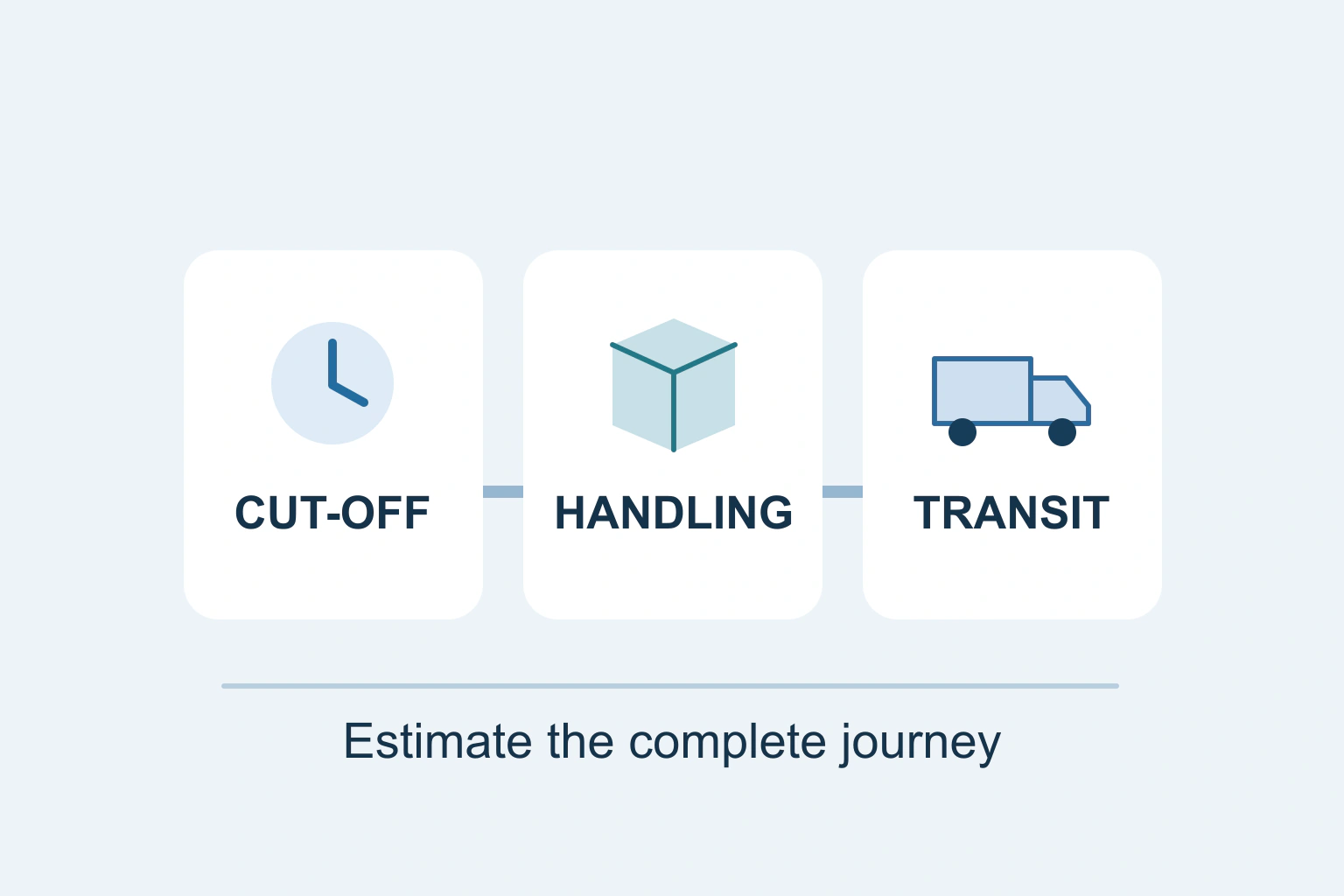
A delivery estimate should account for what happens before dispatch as well as the carrier journey. Combine the relevant order cut-off, handling time, working calendars, destination and shipping service. Verify that the product page, checkout and confirmation explain the same expectation.
Two-day shipping is ambiguous when it describes transit while the store needs additional days to prepare the item. A useful estimate makes its starting point and conditions understandable. It does not turn uncertain carrier performance into a guarantee.
Separate handling, dispatch and arrival
Handling covers the store’s work before the carrier receives the parcel. Transit concerns the subsequent journey. Dispatch is a milestone rather than an arrival date. Keep these concepts separate so a fast carrier option does not conceal a long preparation period.
Google Merchant Center’s delivery-time guidance uses cut-off, handling and transit inputs. Its rules concern that destination, but this separation is useful when inspecting your store’s own promise.
Ask the fulfilment team which event starts preparation: placed order, successful payment, approved artwork or another documented condition. A personalised item can require different treatment from an in-stock item. Explain the dependency where it affects the customer’s decision.
Write the calendar before calculating dates
Record the store’s time zone, order cut-off, handling days, carrier collection days and delivery calendar. Include public holidays and known service exclusions. Do not assume that warehouse working days and carrier delivery days are identical.
| Input | Question | Common mismatch |
|---|---|---|
| Cut-off | Before what local time can handling start? | Time shown without a time zone |
| Handling | How long before hand-off? | Transit label implies the entire journey |
| Destination | Which service and exceptions apply? | One estimate covers excluded areas |
| Calendar | Which days count at each stage? | Weekend or holiday counted incorrectly |
Make exceptions visible to the person maintaining estimates. A temporary warehouse closure is not a change to a product’s specifications, but it may affect every arrival message. Assign an owner who can update operational settings and the associated copy together.
A worked calendar example
Consider a fictional store handling orders on weekdays, with a Friday noon cut-off and one handling day before a two-business-day carrier service. Under its policy, an order after Friday’s cut-off cannot begin preparation that same Friday.
Write the sequence using the system’s actual counting convention: when handling starts, when collection can happen and which carrier days then count. Confirm inclusive and exclusive day counting against the fulfilment policy before publishing a calendar arrival date.
This example deliberately does not supply a universal weekday formula. Systems define day zero, cut-offs and collection timing differently. The useful test is whether the configured result matches the documented sequence for an order on each side of the cut-off.
Apply destination and product rules
Mainland, remote-area and international services may have different transit ranges. Ask for enough destination information before showing a precise estimate. If the page does not know the address yet, use qualified guidance rather than implying that one date applies everywhere.
WooCommerce’s shipping-zone documentation says customers match the first applicable zone. A broad region can therefore capture an address before a narrower exception is reached. Zone ordering belongs in the review of the offer customers actually see.
Check backorders, slow-preparation products and supplier-fulfilled products separately. A mixed basket might ship together or split into parcels. Explain the policy and confirm that checkout does not imply all items follow the fastest product’s timetable.
Choose a method you can maintain
Platforms can offer manual ranges, automated predictions or a combination. Shopify’s delivery-expectations overview distinguishes these options and their conditions. Check what is currently available to the actual store rather than copying a feature from another plan or region.
Manual rules need maintenance when staffing, service areas or preparation times change. Automated predictions still need review against observed fulfilment and the destination. Neither removes the need to notice exceptional delays or explain a prerequisite the customer must satisfy.
Use descriptive guidance when precision is unsupported. Explain that preparation takes the stated range and available services appear after entering an address, if that is how your checkout works. Do not add a fabricated countdown merely because competitors display one.
Test boundary cases through checkout
Create a matrix covering orders just before and after cut-off, a weekend, a holiday, an ordinary destination, an exception region, a slow-preparation item and a mixed basket. Use a safe platform testing route. Avoid charging real customers simply to inspect wording.
Record the service, destination region, relevant settings and displayed result. Repeat on a phone where labels wrap and qualifications may be pushed below the visible area. Ask a reviewer whether the date means dispatch or arrival without giving extra coaching.
Follow the journey into confirmation emails and order status. A product page promising one thing while an email promises another leaves support to resolve the contradiction. Inspect alternative checkout routes too when their delivery displays are maintained separately.
Respond when the operation changes
Compare hand-off and delivery records with the intended ranges over a meaningful period. Separate store delays from carrier delays and address-specific exceptions. Updating a general estimate does not resolve an order already affected by a delay; that customer needs the relevant response.
Keep promises proportionate to the service the business can support. If a delivery service is guaranteed, verify its actual conditions, exclusions and remedy instead of applying the label to every parcel. Ordinary estimates should remain recognisable as estimates.
Keep a copy of the changed rules, date and affected placements. Review banners, product feeds, policy pages and automated messages together. Otherwise an accurate checkout may sit beside a stale search listing or old promotional promise.
Delivery information is a maintained operational expectation. It works when the fulfilment process, settings and explanation remain connected. Start with a truthful range, test difficult cases and refine the message from actual evidence rather than choosing the most persuasive date.
Include an unsupported destination in the test matrix. The visitor should receive a clear explanation when no delivery service applies, rather than a reassuring date carried over from another address. Check what happens after the address is edited, because an estimate must update or be withdrawn when its underlying conditions change.
Continue with the relevant checks
Format currencies and amounts consistently. Test the full checkout before launch. Measure outcomes with appropriate context.
Sources and verification
Editorial review 2026-10-18. Source check dates are recorded separately. Notes describe what each source supports and its limits.
View sources
- Merchant Center estimated delivery timeChecked Separate cut-off, handling and transit inputs.
Limits: Merchant Center-specific counting, not a universal formula. - WooCommerce shipping zonesChecked First applicable zone and ordering.
Limits: Platform-specific; extensions may add rules. - Shopify delivery expectationsChecked Manual and automated dates have conditions.
Limits: Availability depends on store eligibility and current features.