
Review one eligible recipient set for each message and send window. Segment overlap, duplicate records and repeated campaign execution require different controls.
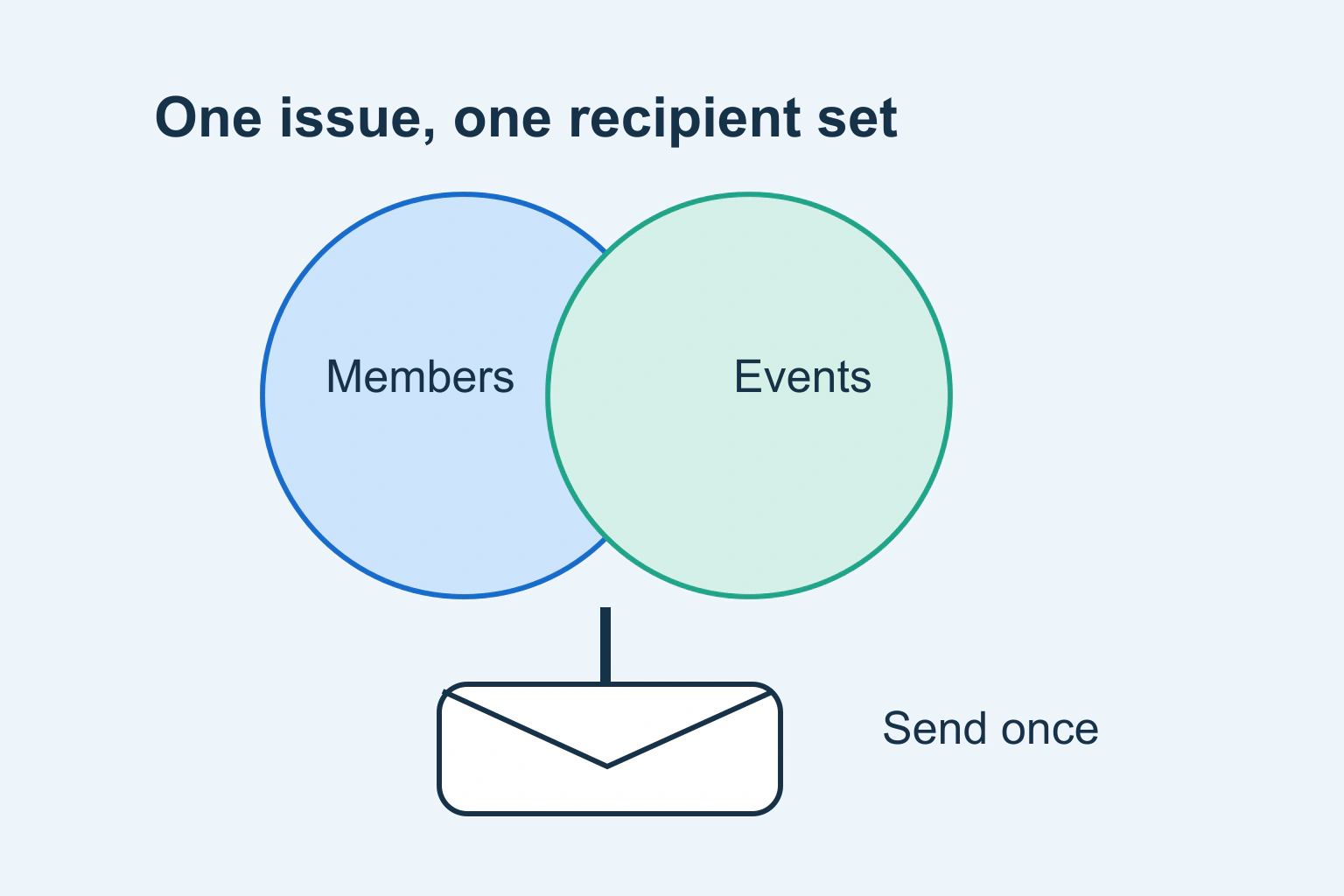
Review the final eligible recipient set for one message, rather than assuming several segment selections will safely combine themselves. Duplicate newsletters can arise from overlap, repeated campaigns, parallel automations or separate audience records. Identify which mechanism caused the repeat before changing the list.
A fictional museum sends a weekend events newsletter to members and workshop subscribers. Some people belong to both groups. The figures below are invented arithmetic to explain recipient-set logic, not evidence from a real mailing platform or audience.
Separate the kinds of duplication
A contact can legitimately meet several interests without being a duplicate person to delete. A platform may store one contact with several tags, separate records across audiences or distinct subscription channels. These models have different sending behavior. Confirm how the actual system treats each.
Two campaigns can also send the same message independently even when each campaign deduplicates its own recipients. Similarly, a welcome automation and a scheduled newsletter can contain overlapping content. Cleaning addresses will not prevent a duplicated execution route.
Start the incident record with message identity, campaign identity, received timestamps and the relevant platform reports. Ask only for necessary evidence through a protected support route. Do not publish recipient addresses or private message headers to demonstrate the problem.
Write the set operation in plain language
The museum has 300 eligible members and 220 eligible workshop subscribers, with 80 people in both groups. Sending one message to their union means 440 recipients before any further exclusions: 300 plus 220 minus 80. Sending two separate campaigns can create two messages for those overlapping people.
This arithmetic assumes the counts describe the same observation time and identity unit. It does not establish how a particular platform will combine audiences. If one figure includes unsubscribed records and the other includes only subscribed contacts, reconcile those definitions before calculating.
Mailchimp’s segment introduction explains AND and OR logic. Translate the actual operator into the intended meaning: people satisfying either interest, then required eligibility and exclusions. Do not use AND when the intention is either group, or OR when all permission conditions must be true.
Define a final recipient manifest
| Layer | Question | Review result |
|---|---|---|
| Inclusion | Who should receive this issue? | Union of relevant interest groups |
| Eligibility | Who is currently permitted and deliverable? | Subscription and suppression respected |
| Exclusions | Who should not receive this particular send? | Specific reasons preserved |
| Execution | Has this message already been sent or queued? | One approved campaign route |
A manifest need not be a widely distributed address spreadsheet. It can be the saved recipient rule, current count, snapshot time and a protected platform preview. Retain only the recipient-level evidence genuinely required to validate the decision.
Use a stable internal campaign name and distinguish the message from its send instance. A revised subject line is not necessarily a new issue. Agree whether resending a correction is intentional, who approves it and which recipients should receive it.
Test overlap and exclusions explicitly
Create synthetic test contacts covering members only, workshops only, both groups, neither group and suppressed states in a suitable private test setup. Verify the expected membership for each. Do not test by importing arbitrary real addresses or bypassing opt-outs.
Review missing fields, case handling and normalization according to the platform’s documented model. Avoid aggressive address transformations: different valid addresses should not be silently collapsed because they look similar. Conversely, cosmetic formatting should not create accidental repeat records when the platform offers a supported normalization route.
The segmentation-options reference illustrates available criteria and their distinct meanings. Some conditions depend on campaign activity and reporting. Check whether a saved condition has the data needed at the relevant time, rather than assuming a preview proves future membership.
Do not merge audiences as a casual fix
A structural merge can alter or lose fields, subscription context, history or automation behavior. It is a different operation from sending one message to a reviewed union. First determine whether the duplicate problem can be solved in the campaign selection without reorganizing the whole account.
Mailchimp’s combine-audiences documentation describes permanent actions, data that does not transfer and potential automation triggers. That makes a merge something to plan deliberately, not a universal recommendation for every overlapping segment.
If a supported consolidation is genuinely needed, preserve consent, suppressions, preferences and required records, identify data that cannot be retained through the tool and plan automation effects. Do not re-subscribe an opted-out contact because another audience contains an older subscribed record.
Check every sending route before release
Inspect scheduled campaigns, automations, API-driven sends and any separate team-owned copies. The museum’s marketing editor may have prepared a campaign while a colleague queued the same issue elsewhere. Segment deduplication inside one campaign cannot prevent that second send.
Assign one release owner and a clear send window. Confirm which saved campaign is approved and cancel or hold obsolete drafts through authorized controls. Do not delete historical reports merely because their names resemble current drafts; those records can be needed to explain what recipients received.
If the send system retries a failed operation, inspect its documented execution safeguards. A timeout does not necessarily mean nothing was accepted. Determine whether the campaign already exists or is queued before creating another. Keep operational retry logic separate from intentional resend decisions.
Verify the outcome and handle a repeat honestly
After an authorized send, compare the actual recipient and campaign reports with the reviewed manifest. Confirm that synthetic boundary cases behaved as expected where the test setup supports that comparison. A successful scheduling screen is not evidence of final deduplication.
If duplicates occur, preserve campaign identities and timestamps, pause the affected future route where authorized and investigate the mechanism. Do not immediately send another mass apology that repeats the unwanted message again. Choose a proportionate communication based on the actual impact and organizational policy.
Close with the concrete cause: overlapping campaigns, audience-model assumptions, duplicated records or an execution retry. Record the control changed and the next verification. The useful result is a recipient process that can explain why each person receives one intended issue, without erasing their preferences or pretending all overlap is bad data.
Continue with the next useful check
Sources and verification
Editorial review 2026-10-18. Source check dates are recorded separately. Notes describe what each source supports and its limits.
View sources
- Mailchimp: Getting started with segmentsChecked AND and OR logic determine membership.
Limits: Not a guarantee of cross-campaign deduplication. - Mailchimp: All segmenting optionsChecked Criteria have different scopes and data prerequisites.
Limits: Available criteria depend on platform configuration. - Mailchimp: Combine audiencesChecked Merges have data-loss and automation implications.
Limits: Not a universal solution or authorization to merge.