
Give AI an approved product record, require unknowns to remain unknown, and review every objective claim against that record before publishing. Check variant-specific copy separately.
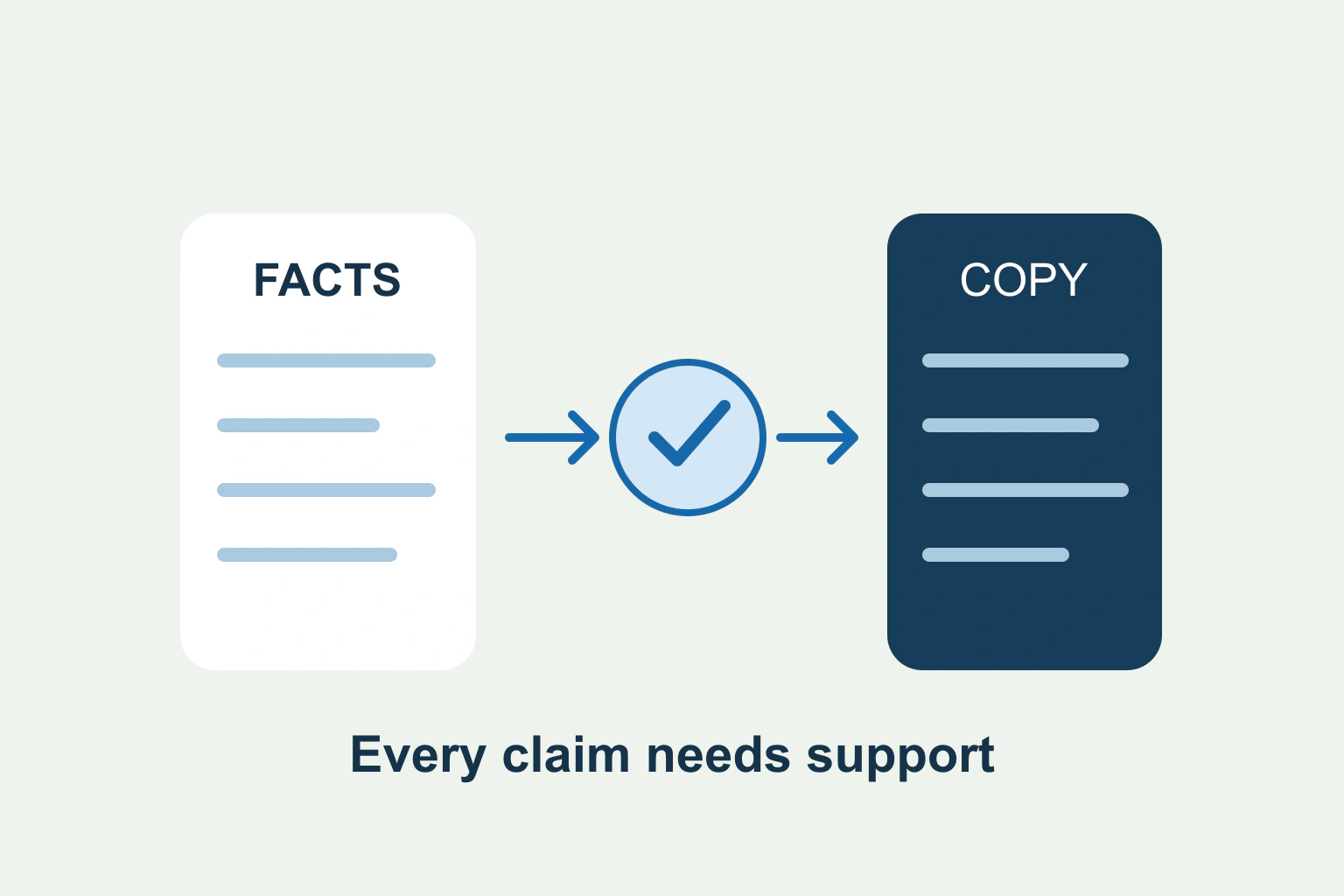
AI can help turn a verified product record into readable copy, but it should not decide what the product can do. Supply approved facts, forbid unsupported additions, and compare every objective claim with the source before publication. Review each variant separately where materials, dimensions or included parts differ.
A fluent paragraph is not evidence. The useful workflow starts with the item the customer will receive and ends with a reviewed description tied to that item. This is a practical editorial process, not a claim that a particular model has been tested or can eliminate mistakes.
Build the product record first
Collect the manufacturer’s current specification, your own verified product information and the exact variant identifier. Separate measurements, materials, compatibility, included components, care instructions and exclusions. Keep the source date and the person responsible for confirming changes.
Resolve contradictions before drafting. If packaging says one capacity and a supplier spreadsheet says another, do not ask the model to choose the more plausible figure. Mark the field unresolved and request clarification. A missing detail is safer than an attractive but unsupported addition.
The NIST Generative AI Profile identifies confidently false output as a risk. The consequence for product copy is straightforward: model confidence cannot replace evidence about the actual item.
Distinguish a fact from its suggested benefit
A verified feature can support a careful explanation, but the connection needs review. A bag with an internal divider can help separate items; it does not automatically protect a laptop from impact. A listed material does not establish an environmental certification, and a connector shape does not prove compatibility with every device.
| Draft statement | Evidence needed | Decision |
|---|---|---|
| Includes an internal divider | Verified construction or specification | Use when true for this variant |
| Protects laptops from drops | Relevant supported protection claim | Remove if unsupported |
| Suitable for every laptop | Dimensions and compatibility evidence | Replace with precise fit guidance |
| Certified sustainable | Applicable current certification | Do not infer from material wording |
Give the reviewer a simple classification: verified fact, reasonable explanation, claim needing specialist support, or unsupported text. This makes review more useful than asking whether the draft “sounds right”. Benefits deserve the same attention as numbers.
Write a bounded drafting brief
Tell the model who the buyer is, which placement the copy serves and which facts it may use. Request a description that preserves units, variant identity and qualifications. Ask it to list unresolved fields separately rather than fill them with assumptions or include internal notes in customer-facing copy.
For example: “Use only the supplied product record. Do not add certifications, compatibility, durability or performance claims. Keep unknown fields out of the description. Return a separate list of statements that need confirmation.” This is a proposed prompt, not a guarantee that a tool will comply.
Keep private supplier terms, customer records and unreleased commercial information out of an unapproved service. Review the tool’s data settings and your authority to share the source material. A product description task rarely requires an export containing every internal purchasing field.
A worked review of a fictional backpack
Suppose the approved record describes a 20-litre bag with a zip closure, one internal divider and a stated outer fabric. The draft calls it waterproof, airline-approved and suitable for all 16-inch laptops. None of those extra claims follows automatically from the supplied facts.
Remove the unsupported claims. Describe the verified organisation features and provide the actual compartment dimensions if available. If fit remains unknown, do not substitute a screen-size guess. Different laptops with the same advertised screen size can have different external dimensions.
The reviewer can retain readable phrasing such as “Keep small items separate in the internal pocket” if that pocket is verified. They should still inspect whether the wording implies secure storage, protection or a capacity not established by the record. Good editing preserves useful explanation while removing invented promises.
Review claims in the market where you sell
The FTC’s advertising overview requires truthful, evidence-based, non-deceptive claims in its jurisdiction. AI assistance does not change the publisher’s need to support the claims it chooses to display. Other markets and specialised products have their own requirements.
Escalate health, safety, financial, environmental or regulated claims to the person qualified to approve them. Do not let an ordinary copy review silently become that approval. Where the product needs warnings or limitations, preserve them in a meaningful place rather than deleting them to make the copy more persuasive.
Also check the combined impression of title, photographs, badges and description. A cautious paragraph can still sit beside an unsupported certification icon or image that implies an included accessory. Review the customer-facing page as one offer.
Keep website copy and product feeds consistent
Map approved facts to the fields your store and sales channels actually use. A rewritten description should not change SKU identity, variant attributes or the included quantity. Preview a parent product and a specific variant to ensure a shared paragraph does not describe features belonging only to another version.
Google Merchant Center’s description reference specifies the structured-description attribute for descriptions created using generative AI. Follow the current destination’s data requirements; a correct paragraph alone does not establish that its feed submission is correctly formatted.
Do not assume updating the store changes every connected channel immediately. Inspect the resulting feed or destination record through its supported workflow. Keep the approved source record so a later discrepancy can be traced to copy, integration or an outdated catalogue value.
Approve the delivered page, not just the document
Read the final title, description, specifications, selected variant and cart line together. Check units, decimal separators and translated wording. Review the page on a phone so warnings, included quantities and important qualifiers remain visible beside the claims they qualify.
Record who approved the copy and which source version it used. Trigger review when the supplier changes the item, when a variant is added or when a claim is challenged. Reusing a paragraph should never mean assuming that every product in the category has the same properties.
Start with a small, varied sample of products before expanding the process. Include incomplete records and similar variants, because those are the cases most likely to reveal weak controls. Measure correction types and review effort; do not treat the volume of generated text as a measure of catalogue quality.
Continue with the relevant checks
Choose an AI tool by its practical task and controls. Check permissions for the images accompanying the copy. Keep the published language accurately declared.
Sources and verification
Editorial review 2026-10-18. Source check dates are recorded separately. Notes describe what each source supports and its limits.
View sources
- NIST Generative AI ProfileChecked Confidently false generated output is a documented risk.
Limits: Risk framework; no model-specific accuracy measurement. - FTC advertising and marketingChecked Evidence-based and non-deceptive advertising.
Limits: US principle, not product-specific legal approval. - Merchant Center description attributesChecked Current AI-generated description attribute requirement.
Limits: Applies to Merchant Center feeds, not every ecommerce system.