
Start with expected mail to eligible engaged recipients, increase deliberately using actual responses, and hold or reduce traffic when evidence shows delivery trouble.
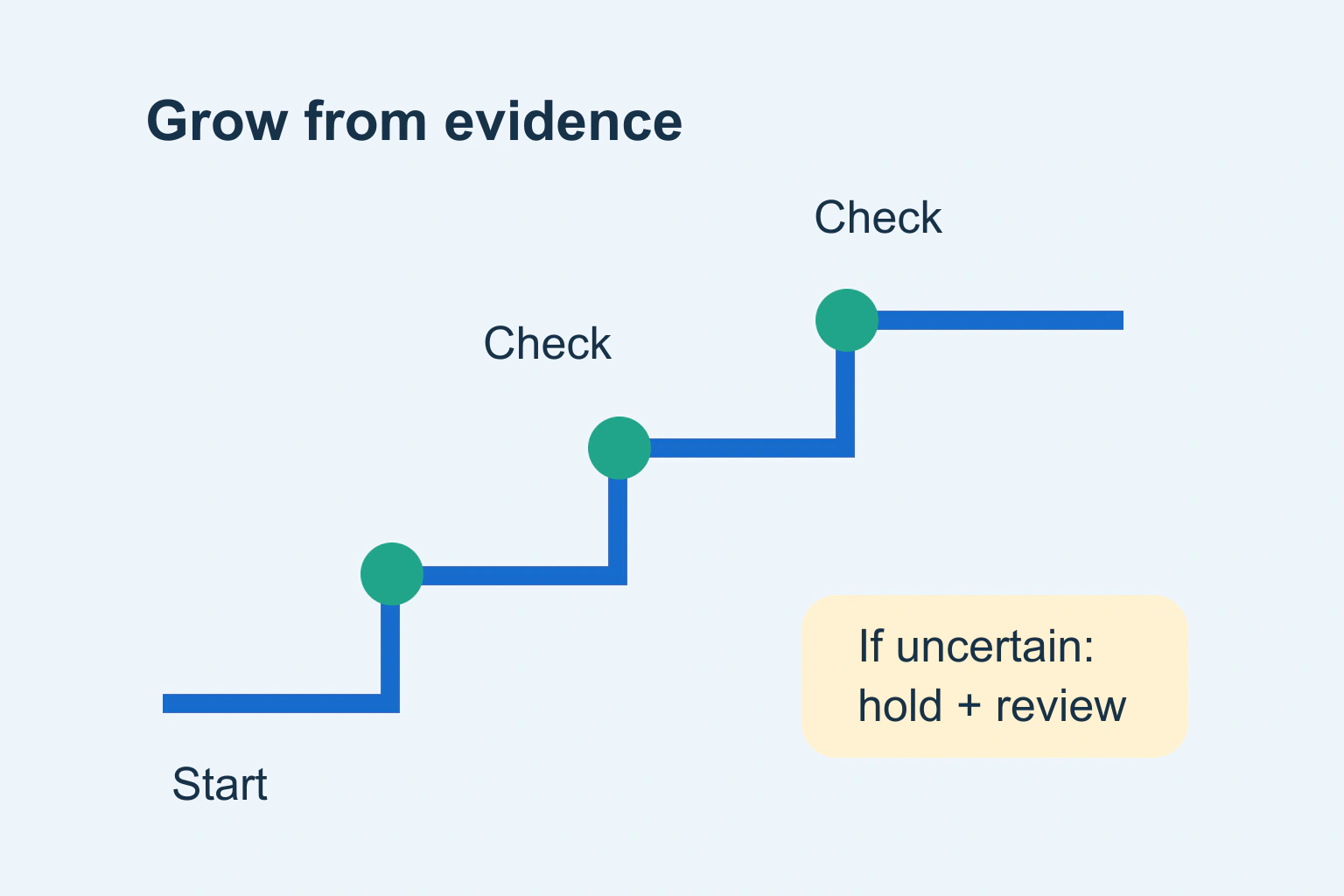
Prepare the sending identity and audience first, then increase expected mail gradually using real delivery evidence. A new domain does not become trustworthy because it was registered a certain number of days ago or because a warm-up service manufactured conversations. The relevant task is establishing consistent legitimate sending behavior that recipients actually expect.
A fictional membership organization is introducing a new newsletter subdomain. The examples describe operating decisions, not a tested schedule or a universal safe daily volume. Different providers, audiences, infrastructure and sending histories require different plans.
Establish why the sending identity is changing
Write the business reason: separating a newsletter from account notices, changing a legitimate organization identity or introducing a new approved platform. Record which visible address, signing identity, return path and infrastructure will change. A provider migration can alter more than one element even when the visible address stays the same.
Do not rotate domains to escape complaints or conceal the sender. A recognizable identity and clear relationship help readers understand the message. Repeatedly moving to unfamiliar lookalike names can create more confusion rather than repairing the underlying audience or content problem.
The M3AAWG sending-domain guidance discusses consistency, segmentation and reputation across the sending arrangement. Its older practical guidance should be combined with current receiving-provider requirements, rather than treating a historical average warm-up period as a deadline that guarantees success.
Complete readiness before expanding volume
Have the authorized operator verify the provider’s current domain setup, authentication and relevant DNS requirements. Confirm the actual sent message uses the intended identity. A dashboard badge alone does not prove every mail route uses the same configuration.
Check unsubscribe and preference handling, reply monitoring, suppression imports and bounce processing. If a person opts out during the ramp, the next batch must respect that state. Do not copy a static address export repeatedly while ignoring preference changes occurring in the live system.
Google’s sender guidelines recommend consistent sending and gradual increases while monitoring responses. Apply the requirements relevant to your actual sender class and destination. Meeting them is necessary operating work, not a promise of a particular inbox placement.
Define an eligible initial audience
Begin with people who legitimately expect this category of message and whose recent deliberate activity supports relevance. Keep permission and engagement separate. A recent buyer is not automatically a newsletter subscriber, and a purchased address list does not become suitable because it is used in small batches.
Explain the identity change where that would help recipients recognize the organization. Keep the first message useful and consistent with the relationship. Avoid introducing an unfamiliar domain, a new offer type and a much higher frequency simultaneously.
For the fictional organization, the initial cohort contains opted-in members who recently requested the newsletter, with current suppressions applied. New registrations with uncertain confirmation and migrated records lacking permission context remain outside the initial send until their eligibility is resolved.
Use decision gates instead of a rigid calendar
| Observed condition | Decision to consider | Required check |
|---|---|---|
| Expected delivery responses and useful feedback | Consider a measured increase | Audience remains eligible and comparable |
| Deferrals or unusual rejection responses | Hold or reduce expansion | Read the specific response and provider advice |
| Authentication inconsistency | Correct the affected route | Verify actual messages after correction |
| Unexpected complaints | Review relevance and collection practices | Stop treating volume growth as the only objective |
Agree the next batch and observation period before sending. Record who can approve expansion and who can pause it. The plan can describe relative changes without publishing an invented universal number of messages per day.
Do not increase merely because the calendar says day three. If the previous cohort produced unresolved responses, expanding makes the problem harder to interpret. A slow start is useful only when the observations actually inform the next decision.
Monitor the evidence at the right level
Review delivery responses by receiving provider and relevant sending route. Aggregate totals can hide a problem concentrated in one destination. Retain the actual response categories, dates and affected counts without exposing individual recipient data unnecessarily.
Yahoo’s sender best practices emphasize wanted mail and responsible traffic control. Use receiving-provider guidance to interpret its own signals; do not assume one provider’s dashboard definitions or complaint calculations apply identically everywhere.
Keep the open-rate and automated-click limitations in mind without making them the central ramp metric. A sudden observed open increase is not a reliable certificate of reputation. Replies, complaints, unsubscribe outcomes and completed intended tasks describe different parts of the relationship.
Hold and investigate when problems appear
If mail is deferred or rejected, read the specific response and the provider’s current troubleshooting instructions. Distinguish transient limits from invalid recipients, authentication failures and policy issues. Repeatedly retrying without understanding the response can worsen the operational load.
Keep essential account or transaction messages under their own approved operating plan. Do not interrupt required customer notices simply because an optional promotional ramp needs investigation. Likewise, do not mix promotions into those notices to bypass a newsletter restriction.
If the audience source proves unsuitable, stop expanding that cohort and review how addresses were collected. Changing a subject line or buying another domain cannot repair missing permission. Preserve suppression records and document the decision rather than silently importing the same people again later.
Move from ramp to normal operations
Define the intended steady cadence and audience size, then document when the new arrangement supports that normal workload with acceptable observed behavior. Avoid declaring success solely because one message was delivered to an internal test account.
Keep monitoring after the initial ramp. Large campaigns, seasonal gaps, changed headers and provider migrations can change the sending pattern. Update the plan when a meaningful part of the arrangement changes, with a clear owner for reviewing the effect.
Close the introduction with the verified identity, permitted audience rules, observed limitations and agreed ongoing process. The objective is sustainable expected communication. There is no universal number of warm-up days that guarantees inbox placement, and no legitimate reason to manufacture reader activity to make a report look healthy.
Continue with the next useful check
Sources and verification
Editorial review 2026-10-18. Source check dates are recorded separately. Notes describe what each source supports and its limits.
View sources
- M3AAWG: Sending Domains Best Common PracticesChecked Identity consistency, segmentation and controlled ramp considerations.
Limits: Published 2019; current provider requirements take precedence. - Gmail: Email sender guidelinesChecked Gradual increases, monitoring and response to delivery problems.
Limits: Does not provide a universal safe schedule. - Yahoo: Sender best practicesChecked Wanted messages, sender requirements and traffic control.
Limits: Provider-specific; no guaranteed placement.