
Compare the total cost for your realistic period of use and the cancellation terms, rather than treating a monthly-looking price as a monthly commitment.
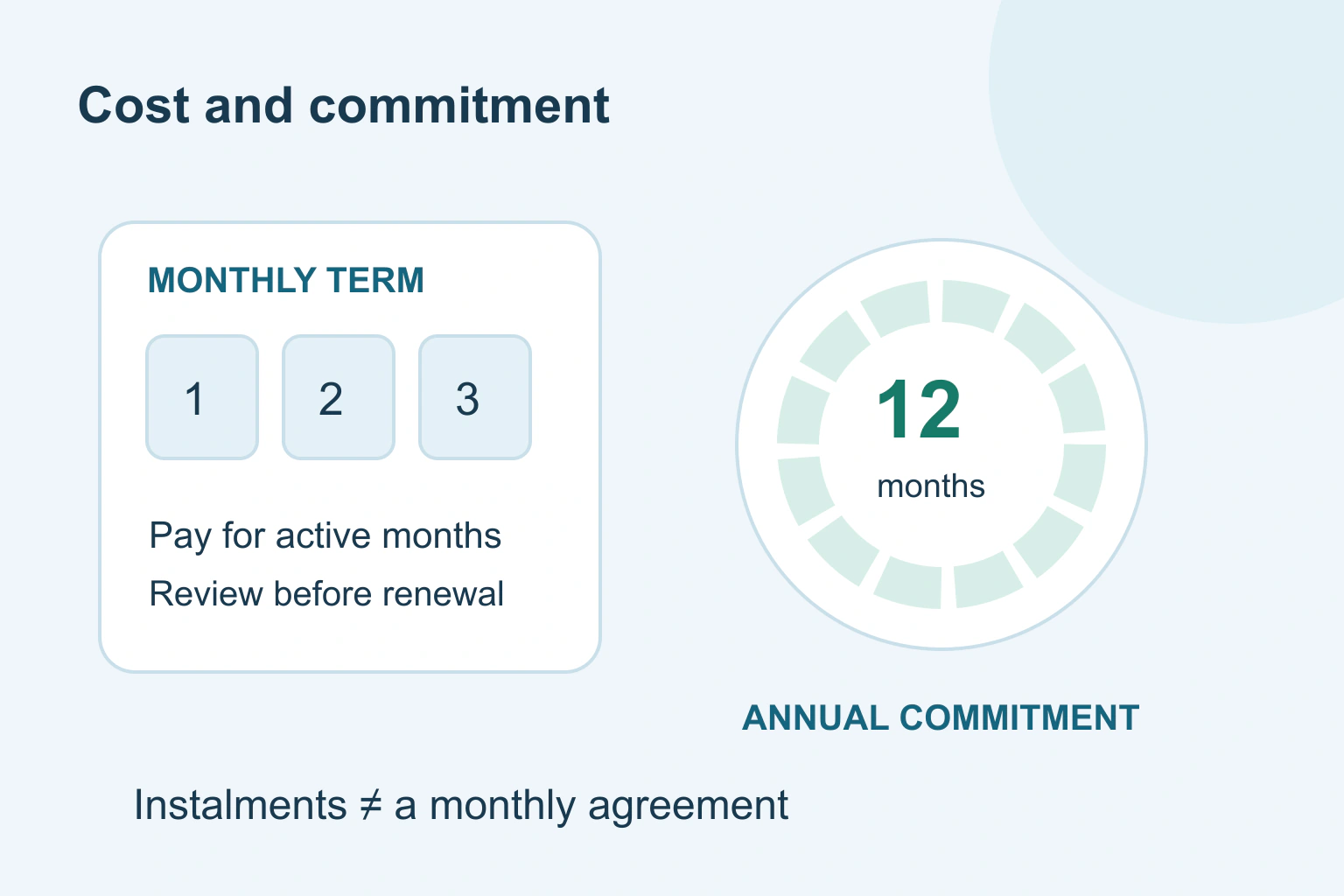
Choose an annual software plan when you reasonably expect to use it for most of the year, understand the commitment and can afford the payment. Choose a genuine monthly plan when you are still learning, have a short project or value the option to leave. A lower displayed monthly equivalent does not automatically make an annual plan cheaper for your situation.
First find out whether “per month” describes a monthly agreement, an annual payment divided by twelve or instalments on an annual contract. Those are three different arrangements.
Separate the payment schedule from the commitment
A month-to-month plan usually covers one renewing period at a time, under its own terms. An annual prepaid plan charges for the year in advance. An annual plan billed monthly spreads payments over the year but may still commit you for that annual term.
Adobe’s subscription terms provide a concrete example of these different arrangements and their cancellation conditions. Do not copy a fee or refund rule from one plan into another. Read the section for your product, purchase route and country.
Write the description beside the price: “monthly term”, “annual term, prepaid” or “annual term, monthly instalments”. If you cannot identify it, ask the seller before buying. A payment instalment tells you when money leaves; it does not by itself tell you when your obligation ends.
Compare the months you are likely to use
Estimate a realistic period. A tool for a six-week project has a different role from an app you use every workday. If you are unsure, test the main task first using an available trial or a short commitment you understand.
Use this calculation for a simple comparison: monthly plan price multiplied by the number of paid months you expect to need, compared with the full annual price. Include taxes, required add-ons and extra users consistently. Do not compare a tax-inclusive total with a tax-exclusive headline.
| Fictional option | Payment for three months of use | Commitment to check |
|---|---|---|
| Monthly plan: 15 units each month | 45 units if stopped before another renewal | Renewal and cancellation timing |
| Annual prepaid: 120 units | 120 units paid upfront | Refund and annual renewal terms |
| Annual billed monthly: 10 units each month | 30 paid so far; remaining obligation may continue | Annual term and early cancellation |
These invented amounts are arithmetic examples, not current offers. The table does not assume that cancelling creates a refund or releases an annual obligation.
Put flexibility into the decision
If the annual total is 120 units and the monthly option is 15 units, eight monthly payments equal that annual price. Using it for fewer months may favour the monthly option; using it for twelve may favour the annual price. That simple break-even calculation assumes the features are equivalent and ignores any separate costs you must add.
Flexibility also matters when a course ends, work changes or the app turns out to be awkward. Paying more per active month can still cost less overall than prepaying for an unused year. Conversely, repeatedly renewing a familiar daily tool at a higher rate can become unnecessarily expensive.
Do not count a promised future project as certain use. Choose an annual commitment because it fits a credible routine, rather than because buying it makes the routine feel more likely.
Read what happens when the term ends
Check the renewal date, future price rules and whether renewal happens automatically. An introductory annual price may differ from the next year’s amount. Save the order confirmation and the applicable terms rather than relying on memory.
The FTC’s subscription advice recommends understanding later billing and the cancellation route before joining. A reminder should allow time to review the app, move important files if needed and use the correct cancellation process.
Renewal pricing is also a separate item in our WordPress hosting first-year and renewal guide. Its hosting examples differ from ordinary apps, but the habit of separating the first payment from the next one is useful here.
A fictional decision for a short project
Imagine Rosa wants an illustration app to make invitations for an event in two months. She likes the annual discount, but she does not yet know whether she will keep drawing afterwards. Her files also need to remain usable once the invitations are finished.
- She checks that the monthly option is actually month-to-month.
- She compares two or three months of that option with the entire annual payment.
- She opens a sample export outside the app and checks the file she will need later.
- She sets a review reminder and keeps the billing confirmation.
Rosa can choose a monthly plan now and reconsider the annual term if drawing becomes a real routine. That is a practical decision about uncertainty, not evidence that annual plans are inherently bad.
Check access and storage before leaving
Find out what happens to files, editing, shared projects and storage when the paid period ends. Microsoft’s cancellation guidance shows why the purchase route and changed storage allowance can matter. Another app may have different consequences.
If the subscription hosts a website, use the more detailed website export checklist before cancelling. For an AI tool, our selection guide adds usage and review costs to the comparison.
Your next step is to write three figures and one sentence: the amount due now, total committed amount, likely renewal amount or rule, and how long you genuinely expect to use the app. Make the term fit that need.
Sources and verification
Editorial review 2026-10-18. Source check dates are recorded separately. Notes describe what each source supports and its limits.
View sources
- Adobe: Subscription and Cancellation TermsChecked Annual billed-monthly, annual prepaid and monthly arrangements can carry different commitment and cancellation conditions.
Limits: Conditions vary by plan, market, purchase date and route; no quoted universal cancellation fee. - Microsoft: Cancel a Microsoft 365 subscriptionChecked Cancellation route depends on who supplied the subscription, and expiry can change the storage allowance.
Limits: A product-specific example, not a rule governing all software subscriptions. - FTC: Free trials, auto-renewals and negative optionsChecked Read future billing and cancellation details before supplying payment information; keep records and address disputed charges promptly.
Limits: US consumer advice; article makes no claim about current universal cancellation law.