
Define the eligible cohort first, sample its records, preserve consent and protected exceptions, then approve a reversible campaign change with a recovery record.
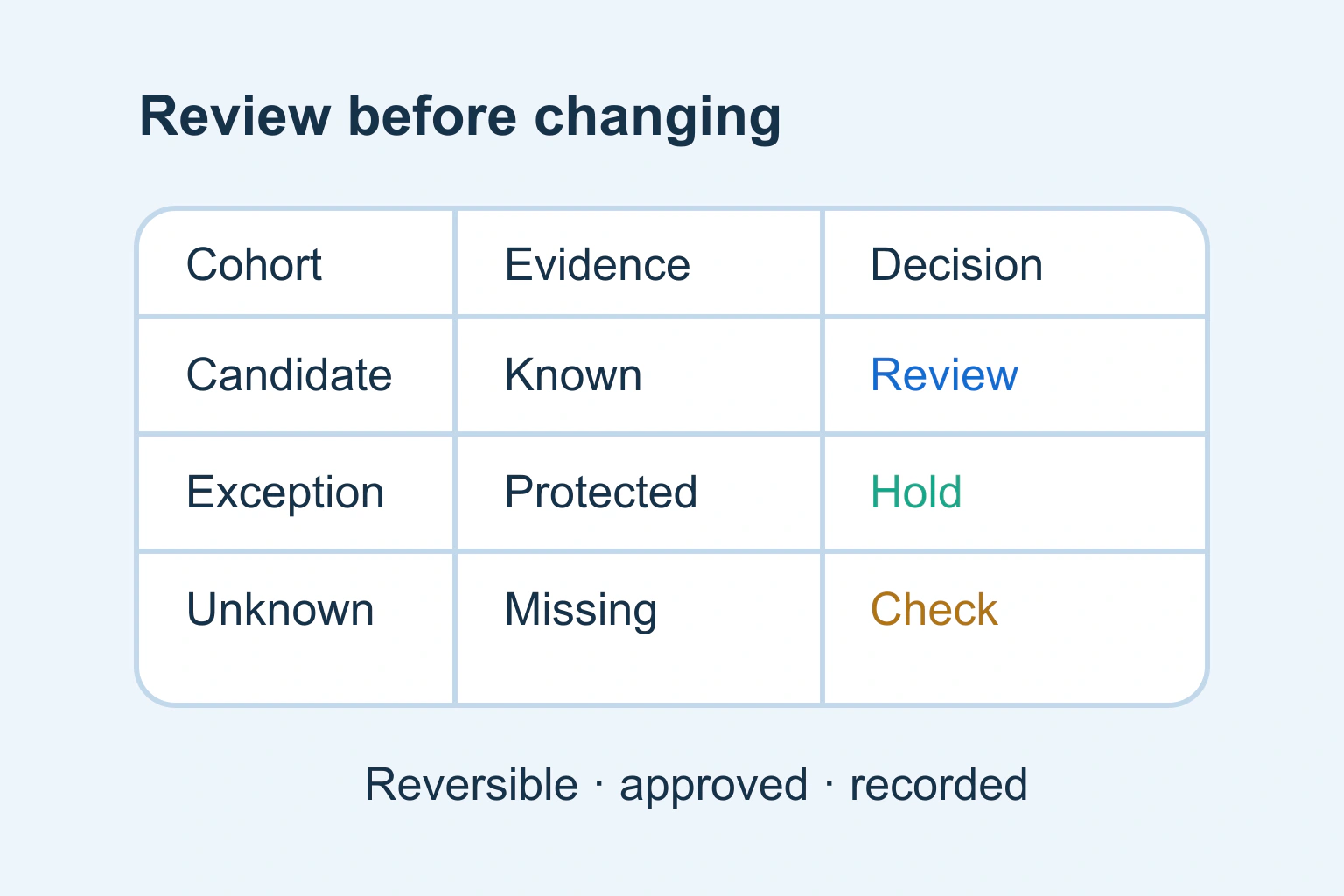
Build and review a cohort before changing a campaign audience. Inactivity should be an operational policy with explicit eligibility, evidence, exclusions and consequences. A segment count is not sufficient approval to delete records or stop communications that the business still needs to send.
This guide concentrates on the review procedure. The existing open-rate guide explains why missing or automated observations can mislead; those limitations are not repeated here. The fictional dataset below is invented to demonstrate decision logic, not a sample of real subscribers or a performance benchmark.
Define the decision and the permitted consequence
Choose one question: for example, whether a cohort should remain in the next optional monthly promotional campaign. Do not quietly expand that into deleting customer accounts, withdrawing transactional messages or erasing the subscription history. Each consequence needs its own basis and authorization.
Write the proposed rule in plain language. The fictional publication reviews contacts who were subscribed before a chosen date, were eligible for the relevant issues and have no qualifying deliberate activity in the review window. It excludes contacts with unresolved support cases from this optional change pending individual operational review.
Mailchimp’s inactive-subscriber guidance makes the inactivity period dependent on context and discusses protecting new subscribers. That supports defining a relevant cohort, rather than adopting a universal number of days as a measure of reader intent.
Create eligibility gates before engagement rules
First check the current subscription and suppression state. Opted-out contacts should not become eligible because another field suggests interest. Invalid or suppressed addresses need their proper delivery treatment. A new contact who has never received the reviewed issues is not comparable to a long-standing recipient.
Next establish whether the necessary data exists. A migrated record with no historical campaign data has an unknown observation window. Do not treat a blank field as confirmed inactivity. Record why the evidence is missing and what consequence remains safe while the gap is resolved.
Finally apply protected operational exceptions. A recent customer, an unresolved support case or a seasonal subscriber may need a separate review rather than blanket treatment. An exception is not automatic permission for marketing. Keep sending eligibility and the business’s customer-service obligations distinct.
Work through a fictional contact sample
| Contact | Known state | Cohort decision |
|---|---|---|
| A | Subscribed yesterday; no relevant issue sent | Exclude as insufficient exposure |
| B | Eligible issues sent; deliberate recent reply | Retain outside inactivity cohort |
| C | Migrated history missing | Unknown; investigate data coverage |
| D | Opted out; later purchase exists | Keep marketing suppression |
| E | Review criteria met; unresolved support case | Protected exception for separate review |
| F | Review criteria met; no protected exception | Candidate for approved reversible change |
These letters identify imaginary records and should not be replaced by a public export of actual contacts. The table’s value is the reasoning. Another operator should be able to reproduce each decision from the defined fields and explain why C is unknown rather than inactive.
Include edge cases deliberately in the private sample: exact cutoff dates, missing timestamps, recent preference changes and contacts present in several segments. A rule that works only for an obvious long-standing contact is not ready for a whole audience.
Validate the saved segment against the written rule
The segments documentation distinguishes AND and OR logic. Check parentheses and exclusions in the actual platform. “Subscribed AND old enough AND no qualifying activity” is materially different from combining those conditions with OR.
Have a second reviewer inspect a small authorized sample of included and excluded records. Check records near the boundary as well as obvious cases. Compare the saved segment’s count with the expected scale and investigate surprising changes before using it for a live send.
Record the data snapshot time and whether the segment is dynamic. A preview today can differ from membership at send time. Preserve the rule definition and an appropriate aggregate audit record, while minimizing exports and protecting any recipient-level evidence required for the review.
Choose a reversible first intervention
Consider a narrow campaign-level exclusion or another supported reversible audience treatment rather than immediate deletion. The proposed action should match the original decision. A contact held out of one optional promotion need not lose all stored preferences or operational communications.
Mailchimp’s archive guidance describes archiving as different from losing all contact data. That is a product-specific option, not an instruction to archive this entire cohort. Verify current behavior, automation effects and restoration conditions in the actual account before acting.
For the fictional publication, F becomes a candidate for a reviewed change to an optional campaign. The owner records the previous membership rule and how to restore it. D remains suppressed. C stays unknown until the team resolves the missing history. The operation does not silently re-subscribe anyone.
Approve the exact change and inspect downstream effects
Before activation, record the cohort definition, estimated current size, exclusions, intended campaign, consequence, approver and recovery procedure. Resolve pending sends and automation membership explicitly. Changing a future rule may not change messages already queued.
Check whether an audience action triggers a welcome, re-engagement or other sequence. A cleanup that unexpectedly sends messages can defeat the purpose of reducing unwanted mail. Use supported previews and a private test audience with synthetic records where practical.
Keep a change window and accountable operator. If a count differs substantially from the reviewed snapshot, pause the affected action and investigate. Do not force the operation through by removing the exclusion that made the count inconvenient.
Review outcomes without erasing uncertainty
After the approved change, confirm the campaign used the intended audience logic and that protected exclusions remained correct. Check preference changes, complaints and operational feedback alongside the intended result. A higher displayed rate after shrinking the denominator does not itself establish healthier reader relationships.
Review the unknown cohort separately and set an owner and due date for unresolved data questions. Do not repeatedly defer unknown contacts while treating the process as complete. If evidence cannot be recovered, choose an explicitly documented conservative policy rather than manufacturing a history.
Close the review when a colleague can reconstruct membership, distinguish permission from engagement and restore the previous campaign rule if needed. That is a more useful operational outcome than a dramatic reduction in list size with no defensible explanation of who was removed or why.
Continue with the next useful check
Sources and verification
Editorial review 2026-10-18. Source check dates are recorded separately. Notes describe what each source supports and its limits.
View sources
- Mailchimp: Identify inactive subscribersChecked Contextual inactivity periods and exclusions for new contacts.
Limits: Does not prove an individual reader is inactive. - Mailchimp: Getting started with segmentsChecked AND and OR rules determine segment membership.
Limits: Behavior and available options depend on account configuration. - Mailchimp: Archive inactive contactsChecked Archiving differs from deleting contact information.
Limits: Not authorization to alter an audience or a universal retention policy.