
Build something worth referencing, identify a genuinely relevant audience and make a factual contribution. Keep paid placements transparent; no quantity of outreach guarantees links or rankings.
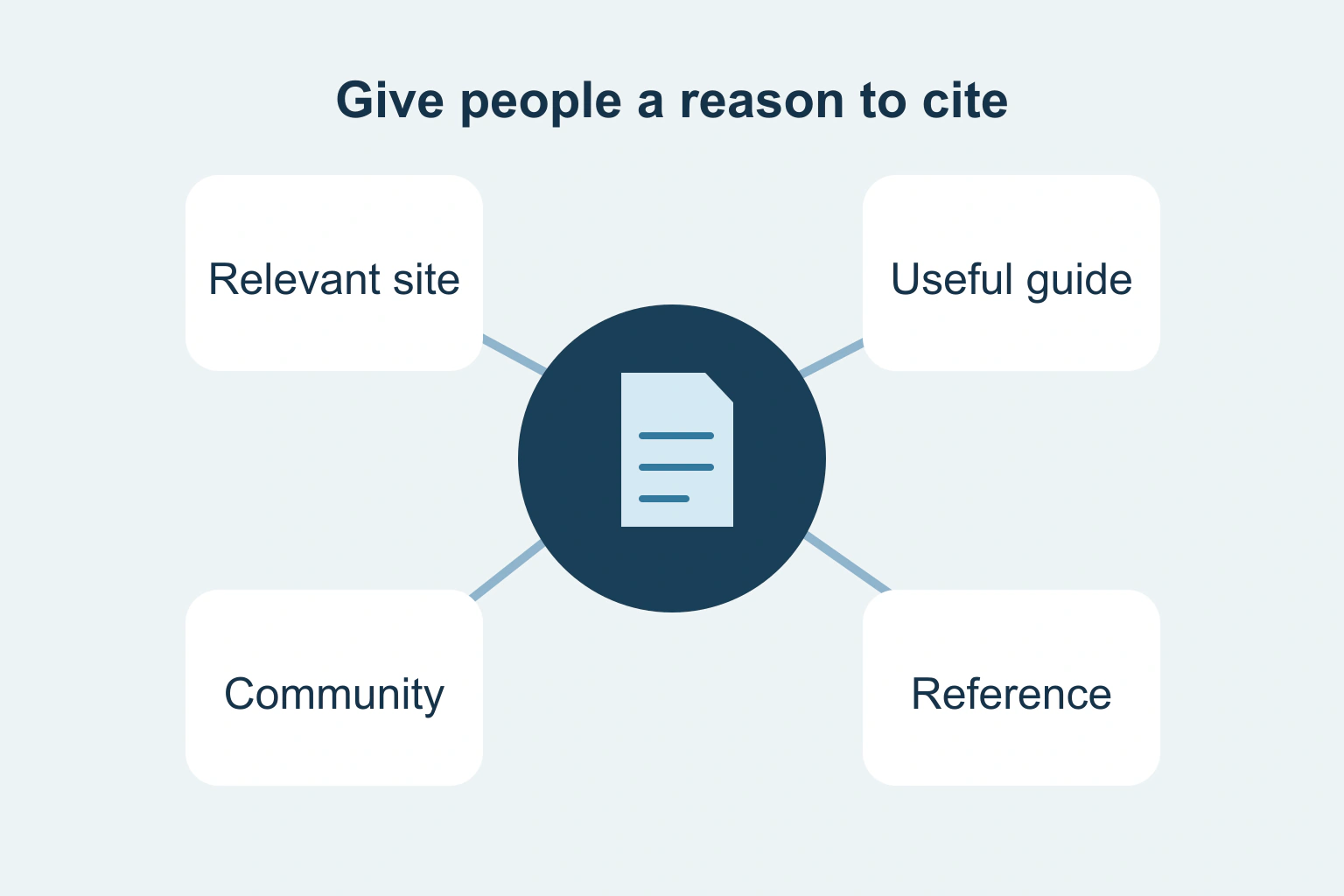
A relevant website reference begins with something useful for another publisher’s readers: original evidence, a clear explanation, a maintained tool or a practical resource. Create that value first, identify who can use it and make a specific contribution. Do not buy a quota of links and assume it represents trust.
No outreach process guarantees links or rankings. A worthwhile result can be a qualified referral, useful conversation or correction to an existing resource. Treat the other publisher’s editorial independence as part of the process rather than an obstacle.
Define the resource and its audience
Choose one reader problem you can answer unusually well. A checklist based on a real workflow, a maintained local reference or a carefully documented dataset can offer more value than another broad article with a sensational headline.
Write down who might cite it and why. A trade association needs material relevant to its members; a tutorial author needs a precise answer supporting their explanation. Anyone with a high-authority domain is not a useful audience definition.
Google’s helpful-content guidance values original effort and useful information. Use that direction to improve the resource rather than treating content as an empty device for soliciting links.
Create evidence another editor can inspect
Make methodology, scope, limitations and update dates easy to find. If you publish figures, explain what was counted and where the data came from. Do not turn a small informal poll into a representative industry survey, or imply practical experience that did not happen.
For a tool or template, state its purpose and boundaries. A calculator with unexplained assumptions can mislead even if it attracts attention. Include a worked example and make the result understandable without requiring trust in a black box.
| Resource | Reason to reference it | Evidence to preserve |
|---|---|---|
| Original analysis | Answers a narrow question | Method, sources and limitations |
| Practical checklist | Helps readers complete a task | Purpose, scope and review date |
| Maintained reference | Saves repeated verification | Inclusion and update rules |
| Expert explanation | Clarifies a difficult decision | Relevant experience and support |
A worked contribution example
Imagine a small business creates a delivery-estimate checklist. It separates handling, transit and destination conditions, includes a blank test matrix and labels hypothetical examples. It does not claim to have measured every store or carrier.
A logistics association maintaining resources might find it useful for members. A sensible message explains the exact gap it addresses, links to the resource and lets the editor decide. It does not demand a keyword-rich anchor or imply an existing relationship.
If the association already has a stronger resource, read it. A factual correction or additional example may be more useful than asking to replace it. Relevance depends on the audience’s needs, not whether your page is newer.
Research recipients before contacting them
Read the target website’s relevant work and contact policy. Identify the person responsible for that subject. Keep a short explanation of why the resource belongs in that context. If the reason only concerns a third-party domain metric, reconsider the approach.
Personalisation means a relevant contribution, not a name inserted into a mass message. Keep requests factual and proportionate. Do not claim to be a long-time reader, customer or expert unless that is true. Respect contact preferences and applicable marketing rules.
This guide describes a proposed process; it does not send messages or authorise contacting anyone. A publisher should also avoid sharing private research or customer information merely to make an approach appear more impressive.
Separate editorial references and paid placements
Google’s spam policies describe link spam, including paid ranking links, excessive exchanges and automated link creation. Avoid arrangements whose primary product is passing ranking credit rather than serving a real audience.
A legitimate advertisement or sponsorship can have a commercial purpose. Keep the relationship disclosed and follow applicable rules. Google’s link guidance says paid links should use sponsored or nofollow qualification. A publisher should not sell unqualified ranking credit as the benefit.
Assess directories and memberships by their actual audience and services. Paying for a professional membership differs from buying a fabricated recommendation, but does not entitle a business to misrepresent endorsement or ignore qualification requirements.
Make the destination stable and useful
Use a public URL opening the actual resource, with a clear title and maintained content. Avoid temporary previews or unnecessary registration. If a download is essential, explain its format and provide enough public information for an editor to assess its relevance.
Give readers a useful next step without turning every section into a sales pitch. A resource can naturally link to a relevant service, but a bait page withholding the answer undermines the reason someone might recommend it.
Maintain appropriate redirects if the resource moves and update facts when they change. A reference earned through useful work stops helping readers if the destination becomes unrelated promotion. Keep the original purpose and publication commitments in view.
Measure outcomes beyond a link total
Record relevant mentions, referring pages, useful visits and enquiries with their limitations. A link count alone does not show audience fit, trust or sales. Search reports may omit or delay data, and ranking changes can have many causes.
Review what helped: the resource, recipient fit, explanation or existing relationship. A few relevant independent references can be more meaningful to the business than many irrelevant placements. Do not assign invented monetary value to every backlink.
Check resulting referrals on the actual page. Visitors need to find the resource promised by the referring description and understand its limitations. A successful link that sends people to an error page or unrelated offer is an operational failure worth correcting.
Set a review date for the resource and outreach process. Retire approaches producing spam complaints or relying on misleading claims. Sustainable promotion begins with work you can defend, reaches people with a concrete reason to care and leaves the editorial decision with them.
Make the resource accessible to the people expected to use it. Check mobile reading, meaningful headings and downloadable-file usability before promoting it. An editor may reasonably decline a useful idea when the destination is difficult to navigate or requires unexplained data collection. Promotion should expose a maintained resource, not compensate for an unfinished one.
Continue with the relevant checks
Maintain original-publication control when syndicating. Read referral and search outcomes in context. Keep resource destinations consistent.
Sources and verification
Editorial review 2026-10-18. Source check dates are recorded separately. Notes describe what each source supports and its limits.
View sources
- Google helpful content guidanceChecked Original effort and useful information.
Limits: No guarantee of links, indexing or rankings. - Google spam policiesChecked Link spam examples.
Limits: Not a legal review of outreach. - Google link best practicesChecked Qualification of paid links.
Limits: Attributes do not guarantee business outcomes.