
Use AI as a reading companion; keep the original beside the explanation and check the conditions that affect your decision.
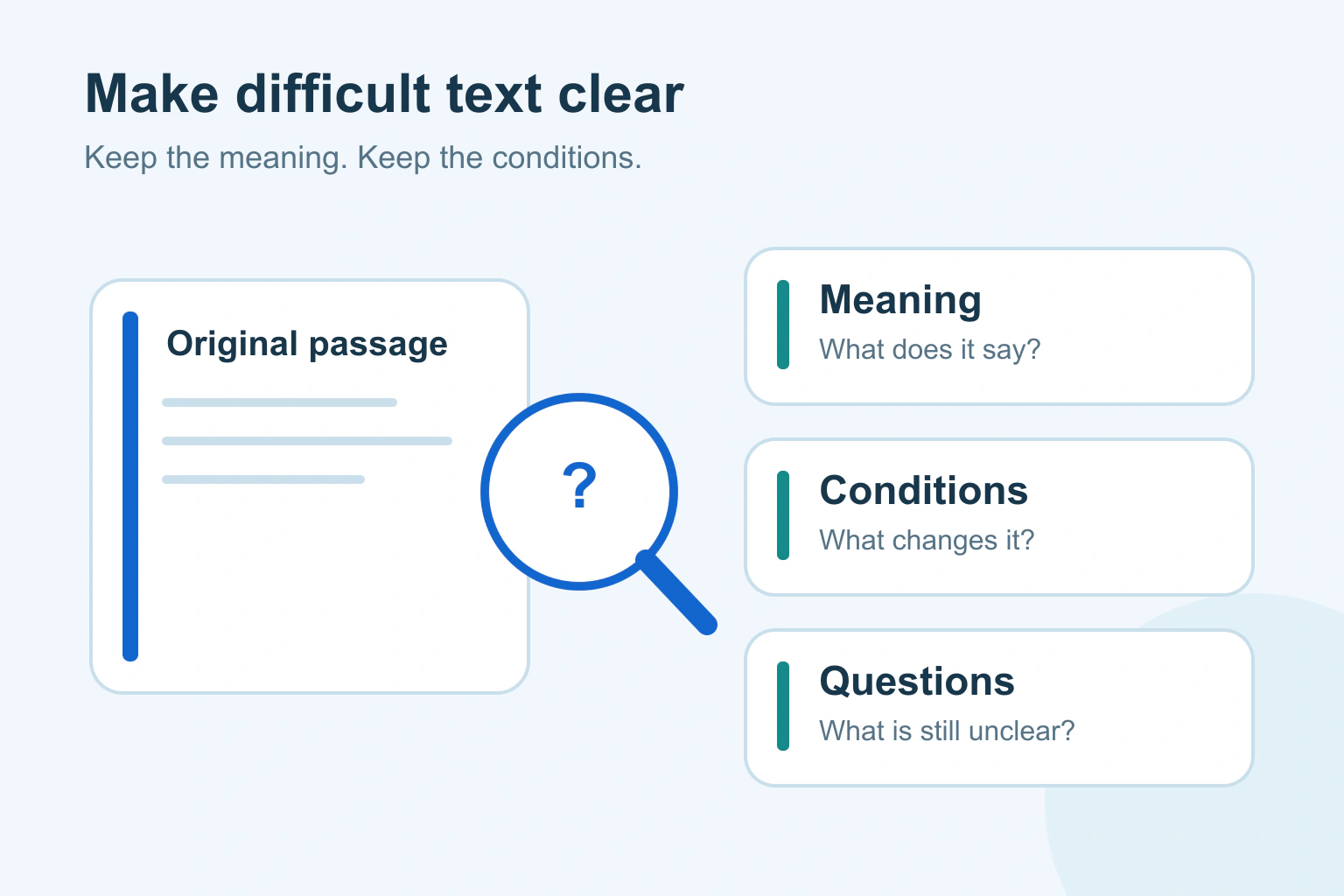
Give the AI a short passage, say which part confuses you and ask for a plain-English explanation that keeps the original conditions. Then compare the explanation with the passage. A shorter answer is useful only if it still means the same thing.
You do not need a clever prompt. You need a clear reading task: understand a return policy, unpack a course description or work out what an instruction asks you to do. Start with one paragraph rather than an entire folder of documents.
Choose a safe passage and a specific question
Copy only the text needed to understand the point. Remove names, account numbers and private correspondence. Check that you are allowed to share it with the service. For a personal letter containing sensitive details, a made-up example with the same confusing phrase may be enough.
Data rules differ between tools and accounts. For example, the Gemini privacy notice describes data use and human review. Do not assume a chat is private simply because it is a conversation. Our guide to removing private information before sharing with AI explains the separate sharing check.
Ask about the actual difficulty. Does “subject to availability” change a promise? Does a sentence contain two different deadlines? Is the problem an unfamiliar word? Naming the obstacle usually produces a more useful explanation than asking the tool to simplify everything.
Use a prompt that preserves the important details
Try this instruction with an ordinary passage you may share: “Explain the text below to an adult who is new to this subject. Use short sentences. Keep every date, number, exception and condition. Define unfamiliar terms. Separate what the passage says from your own example. Tell me if the wording is ambiguous.”
Add the passage underneath, clearly separated from the instruction. If it is a quotation, keep its wording intact. Do not accidentally remove the sentence immediately before it when that sentence explains who qualifies or which product is involved.
Plain language is not baby language. Ask for familiar words and concrete explanations rather than childish comparisons. W3C’s reading-level guidance discusses supplementary explanations and simpler versions for difficult material. It does not certify that any AI rewrite is accurate.
| What is difficult? | Ask for this | Keep checking |
|---|---|---|
| An unfamiliar term | A definition in this sentence | Whether the same term has another meaning elsewhere |
| A long instruction | Numbered actions in order | Every condition and required item |
| A rule with exceptions | The normal rule and each exception separately | Who qualifies and when |
| An abstract idea | A clearly labelled everyday example | Where the comparison stops being useful |
Ask for an explanation, then ask a better follow-up
Read the first answer and identify the remaining gap. “Explain more” can produce another broad paragraph. “Does the deadline apply to sending the request or receiving the item?” gives the next answer a clear purpose.
You can also ask the AI to show which words in the passage support its explanation. This makes the comparison easier, but do not accept a claimed quotation without checking it. The tool can misread or invent a passage just as it can misstate an answer.
For a new concept, ask for one example where the rule applies and one where it does not. This often exposes a missing condition. Ask it to label both examples as invented so that neither becomes a supposed real case.
Work through a fictional delivery rule
Imagine a fictional shop says: “Orders placed before noon on a working day are dispatched that day, except personalised items.” The confusing words are dispatched and working day.
A helpful explanation would say that dispatch means the shop hands the order into its delivery process; it does not promise arrival that day. It would keep the noon cut-off and the exception for personalised items. It would also flag that the shop has not defined working days in this excerpt.
Now test a Friday-afternoon order. The passage alone does not establish an exact arrival date or every holiday rule. If the AI confidently promises Monday delivery, it has added information. Go to the shop’s actual delivery information or contact the shop for that answer.
This example is a reading exercise, not a real retailer’s policy. Its value is learning to notice an extra promise that was absent from the original.
Check the meaning before relying on it
Place the original and explanation side by side. Circle dates, amounts, words such as may and must, and phrases such as only if or except. Make sure each survives in a form you understand. Check negatives particularly carefully: “not required” and “not allowed” are very different.
Google’s response guidance explicitly warns that AI answers can be inaccurate. Agreement from the same chatbot in a second message is not independent proof. For a consequential medical, financial or legal decision, use the relevant qualified source rather than treating a fluent explanation as advice.
If the tool overlooks parts of a large file, our long-document guide explains that separate problem. For an ordinary reading question, return to the smallest complete passage that contains the rule and its exceptions.
Finish by explaining it yourself
Close the AI answer and say the main point in your own words. Add the condition that would change it and the part you still need to confirm. If you cannot do that, ask one more focused question or return to the original author.
Keep the original source address or document with your notes. If the explanation will be shared with someone else, distinguish the original wording from your own summary. Our AI fact-checking workflow is useful when a private reading note becomes something you plan to publish.
Your next step is small: take one non-sensitive paragraph, ask for a clear explanation and check it against the original. The goal is understanding the passage well enough to ask the next sensible question.
Sources and verification
Editorial review 2026-10-18. Source check dates are recorded separately. Notes describe what each source supports and its limits.
View sources
- Google: Gemini Apps Privacy HubChecked Data-handling and human-review considerations before sharing text.
Limits: Applies to Gemini accounts described there, not every AI service. - W3C: Reading LevelChecked Supplementary and simpler explanations can help readers understand difficult material.
Limits: Accessibility explanation, not an accuracy assessment of AI rewriting. - Google: Learn about responses from Gemini AppsChecked AI may provide inaccurate answers and should not replace professional advice.
Limits: Provider warning, not a measurement of accuracy for a particular prompt.