
Store only safely regenerable values in transients, retain authoritative state in its proper system, and make the cache-miss path a normal tested route.
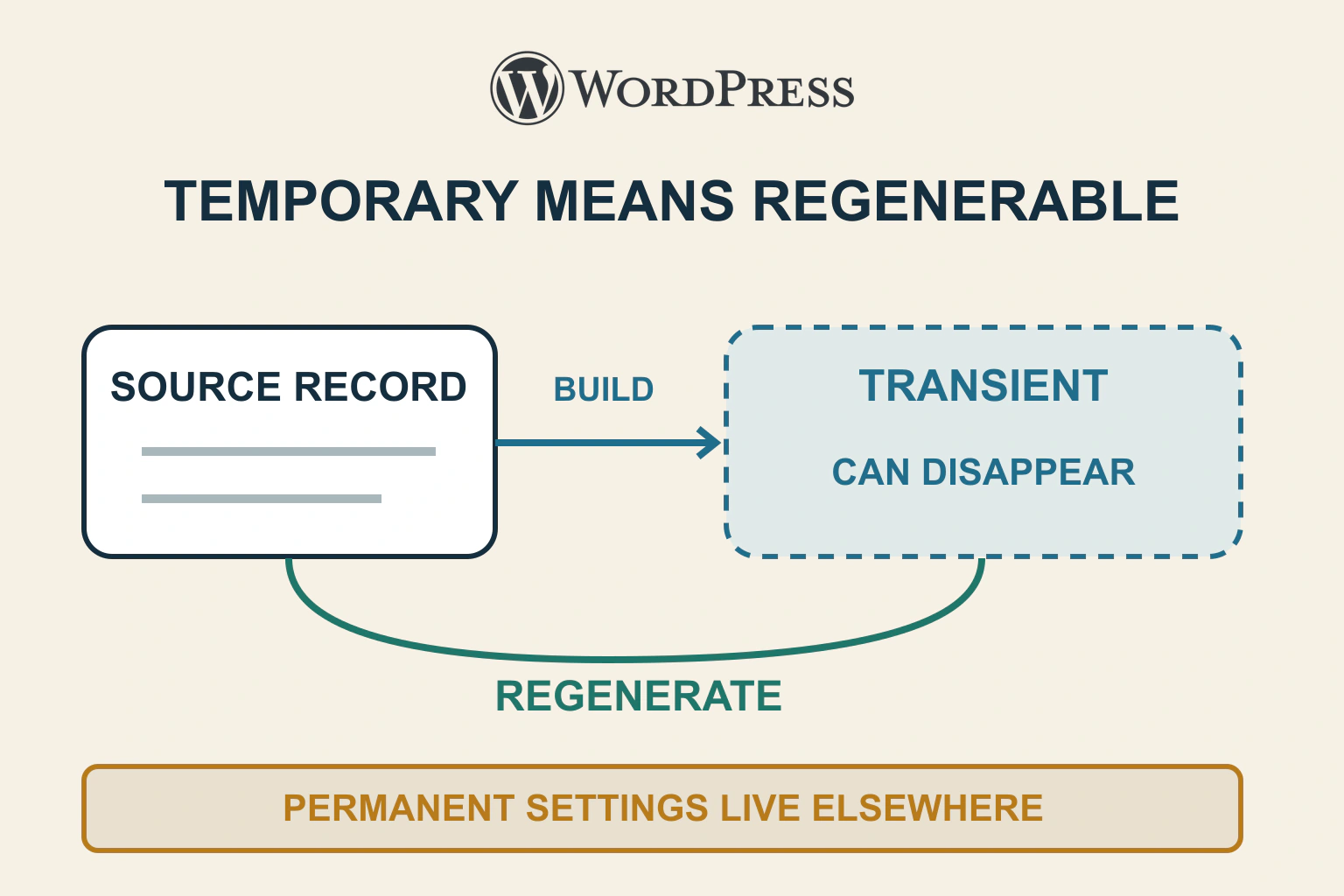
A WordPress transient is a temporary cached value, not a reliable home for information that must never disappear. Expiration is an upper bound, and the value can become unavailable earlier. Keep authoritative data elsewhere and make safe regeneration part of ordinary operation.
In a fictional community directory, a plugin caches the number of open workshops for ten minutes. Workshop records remain in the application database. If the count cache disappears after one minute, the plugin calculates it again. If the booking policy exists only in a transient, the same disappearance becomes a data-design failure.
Identify authoritative and derived values
For each value, ask where it comes from and how it can be recreated. A computed count, prepared public listing or fetched public feed may be suitable cache material. An administrator’s irreplaceable decision or an accepted booking needs authoritative storage.
WordPress’s Transients API handbook explains that expiration is a maximum lifetime with no guaranteed minimum. A transient can disappear early, and an external cache may store it outside the database. Code needs a fallback for unavailable values.
For the directory, document “workshop records → count calculation → transient”. That lineage gives a miss somewhere safe to go. Store the booking policy through the application’s supported settings system instead of relying on the cache key.
Treat a miss as an expected branch
The get_transient() reference documents false for a missing or expired value. Strict comparison distinguishes that result from valid values such as zero. Otherwise “no open workshops” can be mistaken for “no cached count”.
Zero is a meaningful successful answer in this example. If ordinary truthiness triggers regeneration, the application may repeatedly calculate a valid empty result. Where false is meaningful data, use a structure that distinguishes the value from the miss signal.
Make the branches explicit: use a valid cached result, or obtain a fresh authoritative result, validate it and cache it. A miss should not silently become an invented default count merely to keep the page looking complete.
| Value or condition | Meaning | Required response |
|---|---|---|
| Cached count is 0 | Valid empty result | Explain that no workshops are open |
| Retrieval is false | No usable cached value | Regenerate through the supported source |
| Authoritative source fails | Current result is unknown | Use an explicit failure or reviewed stale policy |
| Policy exists only in cache | Authoritative storage is missing | Correct the storage design |
Choose expiration for the result’s meaning
The set_transient() reference describes expiration in seconds and automatic serialization of suitable values. Default zero means no expiration. It does not make a transient permanent or durable configuration.
Choose freshness according to use. A count presented as approximate may tolerate a delay that a place-availability decision cannot. Do not promise live availability while presenting an old summary as authoritative.
For the directory, a cached public count helps browsing, while accepting a booking rechecks actual availability through the supported transaction. Extending cache lifetime cannot solve that acceptance requirement. Record who owns the freshness decision and what public wording reflects it.
Separate regeneration failure from an empty answer
Suppose the count depends on an external feed that becomes unavailable. Failure to fetch does not prove there are zero workshops. Preserve the difference in return values, interface and any cached error policy.
If the product can show previously verified data during a failure, label its age and limitation deliberately. Do not keep an unbounded stale value simply because it avoids an error message. For consequential or private information, a stale fallback may be inappropriate.
Decide how frequently failure is retried. Every visitor triggering an expensive failed request creates unnecessary load. The developer may need bounded retries or a shared regeneration mechanism, but a transient alone does not establish reliable locking or exactly-once execution.
Invalidate when the underlying meaning changes
A time limit is one freshness rule. Adding, closing or moving a workshop can also make the prepared count stale immediately. Identify the component owning those changes and the derived cache entries.
Test closing a fictional workshop through its supported editor and checking the directory. If the count remains old until expiration, decide whether that delay fits the public promise. If it does not, review targeted invalidation in the owning component.
The cache-layer guide covers old page responses. A current transient does not ensure current HTML if a separate page cache still serves an older count. Trace the value and response layers independently.
Inspect the effective backend
With persistent object caching, transient values may not be stored where an older database-cleanup tutorial expects. Absence from the options table does not prove API failure. Inspect the actual backend and retrieval path through supported tooling.
The autoloaded-options guide concerns automatically loaded configuration. Do not combine that investigation with blanket transient deletion based on row sizes. Ownership and regeneration ability come first.
If regeneration is slow, use the query diagnosis workflow to inspect the computation. Repeatedly deleting its cached result makes the expensive path more frequent; it does not improve the computation.
Version the cached result’s shape deliberately when the component changes its schema. A newly deployed reader should not interpret an old list as a new structured count simply because the key still exists. Test an older valid cache value during the update rehearsal and define its supported regeneration route.
Test disappearance on a protected copy
- Start with a populated transient and confirm the correct cached result.
- Remove only the known test entry through supported tooling.
- Verify the next request regenerates the value from its source.
- Check valid zero or empty results without unnecessary repeated regeneration.
- Simulate source failure and inspect truthful recovery.
- Change an underlying record and check the invalidation rule.
- Confirm permanent settings and accepted records remain intact.
Include more than one requesting visitor where the application expects concurrent use. Two near-simultaneous misses can expose an expensive duplicate regeneration path that a single browser never reveals. Keep test scope controlled and compare both correctness and source workload.
Keep key ownership, source, freshness and miss behaviour documented. The next useful improvement is a complete cache lifecycle, not a longer expiration chosen to make a disappearing value seem permanent. Accept the design when a missing transient is routine, recoverable and honest to the reader.
Sources and verification
Editorial review 2026-10-17. Source check dates are recorded separately. Notes describe what each source supports and its limits.
View sources
- WordPress: Transients APIChecked Expiry is a maximum lifetime with possible early disappearance; values may live outside the database; regeneration is required.
Limits: Does not provide a guaranteed minimum lifetime, permanent persistence or a universal stale-data policy. - WordPress: get_transient()Checked Returns false for missing or expired values; strict comparison distinguishes misses from valid zero or empty data.
Limits: Filters and cache integrations can affect the actual retrieval path. - WordPress: set_transient()Checked Sets values with expiry seconds and handles serialization; zero means no expiration.
Limits: No expiration is not a durability or permanent-setting guarantee.