
Preserve exact observations and permission records, then choose a proportionate response with qualified advice when the rights or applicable process are uncertain.
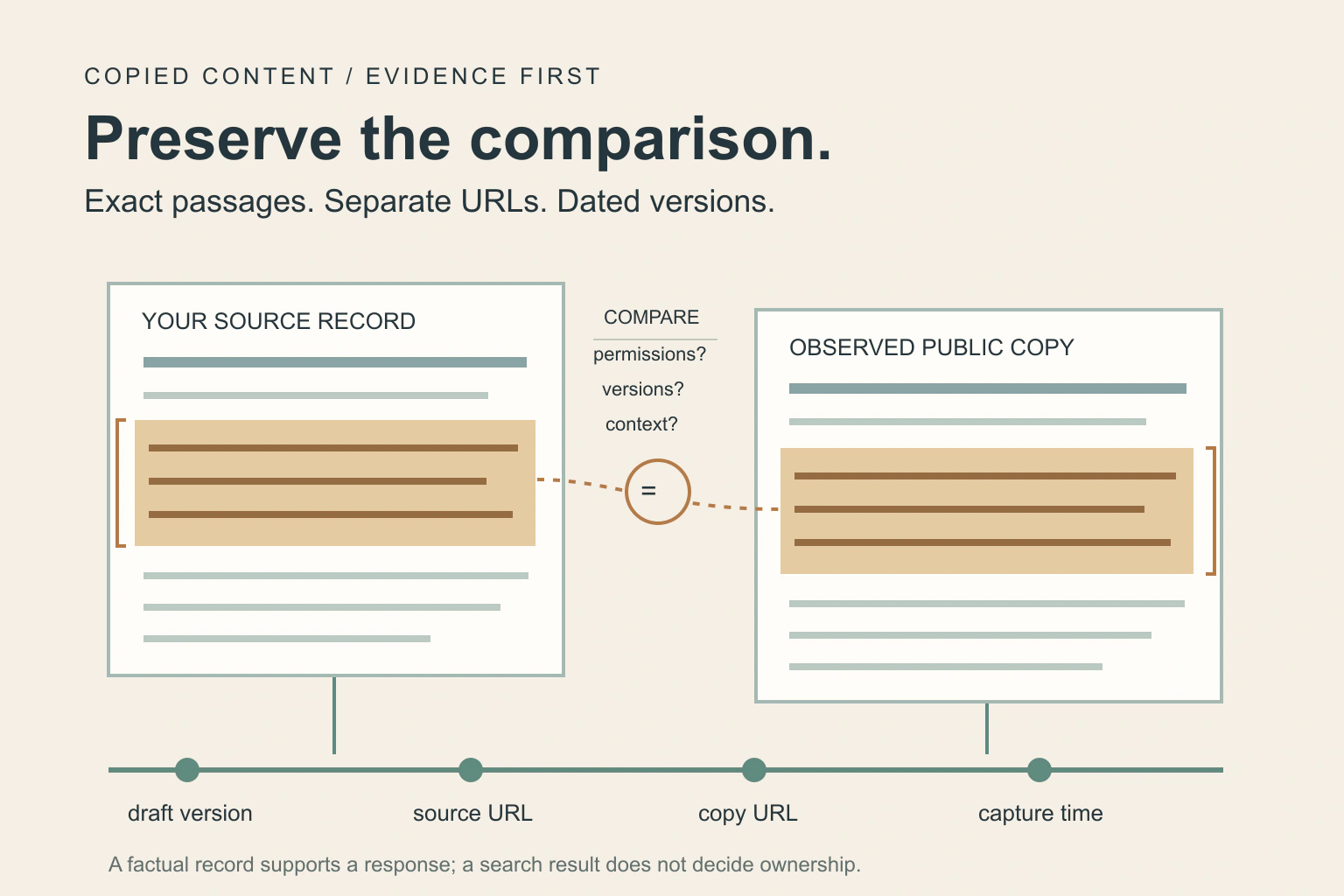
When another website appears to have copied your article, preserve the exact pages, matching passages and your source history before deciding how to respond. Keep the evidence private and distinguish a copying observation from a legal conclusion. A search result or canonical tag does not prove who owns the work.
The first objective is a useful record that survives later edits. It should let an editor, publisher or qualified adviser understand what appeared where, what permission may exist and which action you want considered.
Capture the observed copy without altering it
Record the full public URL, final destination after redirects, observation date and timezone. Save a reasonable screenshot showing the article title, copied passage and enough page context to identify the destination. Retain a local text or page copy where appropriate, keeping the original capture separate from annotated comparison copies.
Do not rely on a search-results screenshot alone. A result can display an excerpt that differs from the current page. Open the destination safely and compare the actual text. Avoid unfamiliar downloads, browser extensions or sign-in demands presented by the other site.
Capture the relevant scope, not every unrelated page. If five articles are affected, make five exact entries. A homepage URL does not identify which article or passage needs review, and a giant unstructured archive makes the problem harder to assess.
Preserve your own publication history
Keep the approved draft, available revision history, source files and relevant commissioning or licensing records. Record the public original URL and any later URL changes. Distinguish the initial publication date from subsequent updates and from the date shown on a template.
A visible date is one signal, not an independently verified creation history. Another page can display an earlier date, and a legitimate migration can change yours. Preserve the underlying records rather than editing dates now to strengthen the appearance of priority.
Where the article includes licensed photographs, quotations or contributed material, document those boundaries. Our image-permission guide explains why credit and permission are different records. Do not claim ownership of every component merely because your article contains it.
Compare passages and permissions separately
| Record | What to include | Limit |
|---|---|---|
| Text comparison | Matching wording and surrounding context | Similarity alone does not settle legal exceptions |
| Source history | Drafts, revisions and publication records | A displayed date is not the whole history |
| Permission history | Licence, commission or syndication agreement | Absence from your inbox is not proof no permission exists |
| Search observation | Query, date, result URL and inspected canonical | Search selection does not decide ownership |
WIPO’s copyright FAQ explains that online availability does not put protected work automatically into the public domain. It also advises assessing whether reproduction is actually infringement, including relevant exceptions, before choosing a response. The applicable rights and process require a situation-specific review.
Ask the person responsible for publishing whether the page was supplied to a partner, commissioned under another agreement or released with a reuse licence. A syndication arrangement can be poorly documented internally. Establish that possibility before describing the other publisher publicly as an infringer.
A fictional garden article appears elsewhere
Imagine a fictional gardening website that finds six consecutive paragraphs from its raised-bed guide on another domain. The editor saves both public URLs, captures the matching sections and retains the approved draft and revision record.
The comparison reveals that the other page has added a new introduction and omitted a safety qualification. The evidence packet records both the copied wording and that omission. It avoids the broader claim that every part of the second article is identical.
The publisher checks its partnership register and finds no recorded permission for this destination. That is an internal finding to investigate, not a courtroom conclusion. The next decision is whether a factual publisher inquiry, host process or qualified legal review is appropriate. No fictional notice is submitted as part of this example.
Keep the search question independent
If the other URL appears above yours, save that result as a dated observation. Search location, query and result format matter. Do not conclude that your entire traffic decline was caused by the copy without a separate page-level investigation.
Google’s canonical troubleshooting guidance acknowledges that its selected URL can differ from a publisher’s preference. That is a search-system decision, not a transfer of rights. Equally, a self-canonical on your page is not a certificate of originality.
Use the canonical and duplicate-URL guide for technical signals on your own website. Do not redirect your original to the copied page or delete your source article to make a report cleaner.
Choose the response destination deliberately
A publisher contact route concerns the publication itself. A hosting process concerns what that host can handle. A search-removal process concerns access through the search product. Those routes have different requirements and effects; one request does not automatically complete the others.
Google’s legal reporting guidance asks for the relevant product, specific URLs and precise context. It also explains that restricted content can remain elsewhere on the web. Read the actual current process and its declarations before submitting anything.
If ownership, exceptions, jurisdiction or the required statements are uncertain, take the evidence packet to a qualified adviser. Do not use a generated legal notice as a substitute for understanding what you are declaring. Review any personal or business details that the receiving process may disclose.
Minimize data in the packet
Remove unrelated customer details, credentials and internal discussions before sharing a comparison. Keep unredacted originals in an appropriate private location. A support screenshot of your editor can reveal account names or unpublished material that the public-page comparison does not need.
If technical records are relevant, our log-investigation guide explains private handling and narrow excerpts. Do not publish visitor logs to demonstrate that an unknown crawler visited your site; the request alone would not prove who copied an article.
Track the result without losing the evidence
- Keep a dated entry for each affected public URL.
- Record permission checks and unresolved ownership questions.
- Choose a response route and obtain the review its declarations require.
- Retain submitted material and any reference number privately.
- Revisit the exact destination and record its current state.
A changed or removed page is a new observation, not a reason to overwrite the original record. Preserve both. Your next step is a concise, factual comparison packet that supports a decision without making unsupported legal or traffic claims.
Sources and verification
Editorial review 2026-10-17. Source check dates are recorded separately. Notes describe what each source supports and its limits.
View sources
- WIPO copyright frequently asked questionsChecked Online publication is not automatic permission; rights, exceptions and responses depend on the applicable situation.
Limits: General international guidance, not a determination of ownership or infringement in a particular jurisdiction. - Google canonicalization troubleshootingChecked Google-selected canonical may differ; copycat and syndication cases are separate technical situations.
Limits: Search canonical selection is not proof of copyright ownership. - Google reporting content for legal reasonsChecked Product-specific reporting, exact URLs and limits of removal from Google products.
Limits: A report is reviewed; removing search access does not remove the source website copy.