
Inspect the actual logged-out rules and their owner, retain ordinary navigation, exclude action/state-sensitive destinations and verify activation behavior before widening speculation.
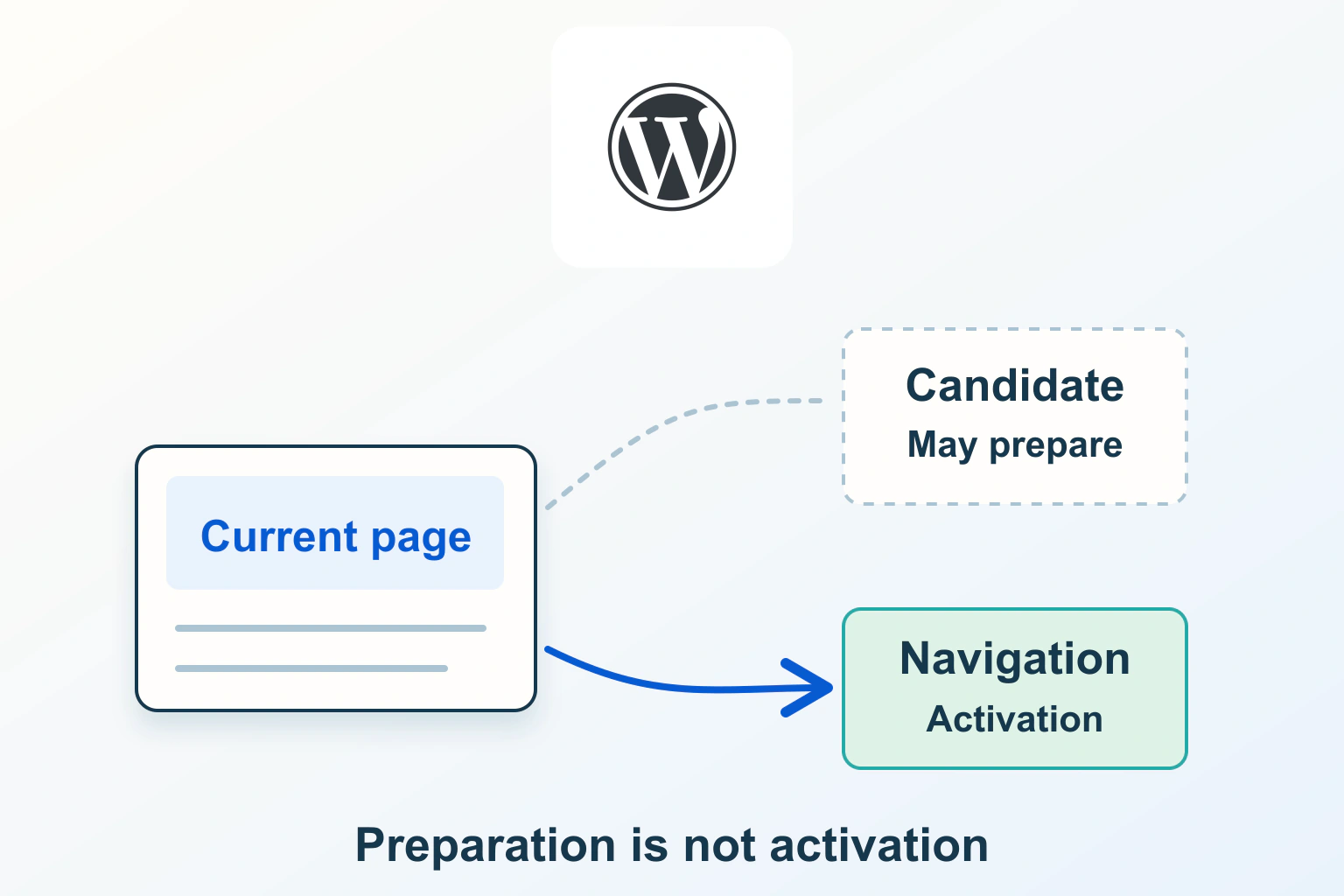
Review what happens before a click before increasing speculative loading. Preparing a likely next page can reduce waiting, but it can also request unused content or run work before somebody chooses that destination. The useful question is which navigations are appropriate to prepare and how the site behaves when a prepared page is actually used.
This guide uses a fictional public archive. It reports a review method, not measured speed improvements or a live WordPress experiment. Ordinary navigation must remain usable when speculation is absent, unsupported, declined or canceled.
Separate prefetch, prerender and returning to history
MDN’s Speculation Rules API guide distinguishes preparing a future document from loading the resources of the page already being read. Prefetch retrieves a prospective document; prerender prepares the page more fully, including resources and JavaScript. Browser availability is limited, and both involve resource costs.
Returning to a previously visited page is another investigation, covered by our back-button state guide. Do not label every unexpectedly quick page or old screen a speculative-load problem.
For the fictional archive, preparing a likely next chapter is different from preparing every search result or an account action. Define the intended journey before choosing a mode or eagerness setting.
Check current defaults instead of an old tutorial
The current WordPress default-configuration reference states prefetch with conservative eagerness. Hosting defaults can be overridden; an explicit configuration supplied through a filter takes precedence. Do not assume that cache detection automatically switches a current installation to moderate behavior.
The configuration reference describes default eligibility for logged-out visitors on sites with pretty permalinks, subject to filtering. An administrator’s logged-in screen may therefore be the wrong observation for a public reader journey.
Record WordPress version, relevant host or optimization integration and the actual emitted page rules. The private default helper documents core behavior; it is not an integration API to call from copied theme code. Use maintained configuration surfaces owned by the responsible developer or provider.
Find the rules the browser really receives
Inspect the exact public starting page in a clean logged-out session and a browser that supports the feature. Confirm the address and final response. Ask which component owns the rule set; adding another optimization plugin without that inventory may create overlapping behavior.
Chrome’s debugging guide explains Application views for rules, candidates, statuses and reasons. Prefetch can be inspected through Network; prerender uses a separate renderer that needs its corresponding inspection context. Reading only the current page’s Network list can miss that distinction.
Record the candidate address, selected rule and outcome before navigating, then whether the eventual navigation used that preparation. A rule existing in the document is not proof that the browser fetched anything, and a ready candidate is not proof that a person visited it.
Review destinations by their effects
List the links available from representative archive, search and account-adjacent pages. Ask what receiving each request does, even without a completed visit. The MDN guide warns about side effects associated with GET destinations. An optimization exclusion does not repair an application that performs a sensitive action merely when its address is requested.
| Destination | Review question | Provisional action |
|---|---|---|
| Public next chapter | Is the response public, stable enough and useful to prepare? | Candidate for controlled evaluation. |
| Unsubscribe or state-changing link | Could a request trigger an action prematurely? | Exclude and have the action design reviewed. |
| Personalized account screen | Could credentials, sessions or state change the result? | Keep out until the integration is explicitly understood. |
| Expensive or rarely followed result | Does preparation spend resources without useful navigation? | Prefer a narrower selection. |
These are editorial review decisions, not findings about a tested archive. The actual route owner must confirm their behavior. Include custom paths, redirects and integration-generated links rather than assuming all actions use familiar dashboard addresses.
Retain core safeguards and add specific exclusions
The current rule-generation reference shows base path exclusions, nofollow link exclusions and no-prefetch/no-prerender opt-outs relevant to the selected mode. Those safeguards do not discover every custom action your site may expose. The generator is private core implementation, not a supported function to invoke directly.
WordPress provides a public href-path exclusion filter for additional paths. Have the maintainer apply installation-specific exclusions through the supported integration, preserving base protections. A copied shop-path list is not enough for an unrelated site’s membership or custom routing.
Check the resulting rules on the actual pages and verify that normal deliberate navigation still works. Do not repurpose nofollow across all editorial links as an unexplained universal workaround. Keep navigation semantics, optimization selection and application authorization as distinct responsibilities.
Review work that should wait for activation
Prerender requires a deeper application review than fetching a document. Chrome’s prerender guide documents document.prerendering, the prerenderingchange event and activationStart timing context. These let implementers distinguish preparation from activation and defer work that depends on a real visit.
Ask the owner of measurement, notifications and other integrations how each behaves before and after activation. A browser lifecycle facility does not prove that every third-party script uses it correctly. Do not count a prepared candidate as a reader engagement or conversion merely because a request appeared in a log.
Keep review data synthetic and use an isolated environment for consequential integrations. The acceptance condition is deliberate intended behavior; an attractive timing number cannot excuse duplicate messages, premature state changes or misleading reports.
Check freshness and the no-speculation route
Test an ordinary direct visit and the prepared navigation to the same destination. Compare current content, account boundaries and essential controls, then check a browser or state where speculation is unavailable. The guide’s purpose is progressive improvement rather than a second version of the site that only works after a special navigation.
If personalized content is involved, use the separate private-response cache review. If an installed application retains older assets, the service-worker update guide investigates that different layer. Do not change several caching systems to explain one candidate’s status.
Make a scoped decision and keep the evidence
For the fictional archive, accept a narrow chapter-to-chapter configuration only after useful destinations, exclusions, activation and fallback behavior are checked. Compare representative journeys under a consistent setup; do not promise a percentage gain or infer a real-reader improvement from one successful laboratory navigation.
Keep the actual rules, configuration owner, checked routes, observed outcomes and untested integrations. If a regression appears, revert the specific authorized configuration through its maintained control and repeat the affected journey. A canceled speculative request alone is not a defect; a sensitive action performed before the reader chooses it is a substantive problem to resolve.
Sources and verification
Editorial review 2026-10-15. Source check dates are recorded separately. Notes describe what each source supports and its limits.
View sources
- WordPress default speculation configuration referenceChecked Current core defaults are prefetch and conservative; hosting defaults can be overridden and explicit filtered choices take precedence.
Limits: Private core function is documentation evidence, not a plugin/theme integration API; actual site output may differ. - WordPress speculation configuration referenceChecked Default logged-out and pretty-permalink eligibility and the supported configuration filter boundary.
Limits: Core eligibility is not universal browser support or proof that a site emits unchanged defaults. - WordPress generated speculation rules referenceChecked Core base path exclusions, nofollow links and mode-sensitive no-prefetch/no-prerender opt-outs.
Limits: Private generation function is not called as an integration API; core rules do not identify every custom action or state-sensitive path. - WordPress speculation href exclusion hookChecked Supported filter for additional site-specific excluded href paths.
Limits: Requires installation-specific path review and testing; a generic example does not cover all account/store/session integrations. - MDN: Speculation Rules APIChecked Limited browser availability, document prefetch versus prerender, resource costs and unsafe side-effecting GET navigation.
Limits: Experimental progressive enhancement; no universal execution, navigation-speed or security guarantee. - Chrome DevTools: debug speculation rulesChecked Application rules and speculative-load statuses, reasons and separate renderer inspection for prerender.
Limits: Chrome-specific tooling; a candidate or ready document is not evidence of a completed reader navigation. - Chrome platform guide: prerender pagesChecked Prerender activation lifecycle and deferring work through document.prerendering/prerenderingchange, with activationStart timing context.
Limits: Not every browser or third-party script supports this lifecycle correctly; pageview or conversion measurement needs its own review.