
Verify the event stream and handler boundaries, retain a meaningful resume position where supported, and reconcile with current application state when replay cannot be guaranteed.
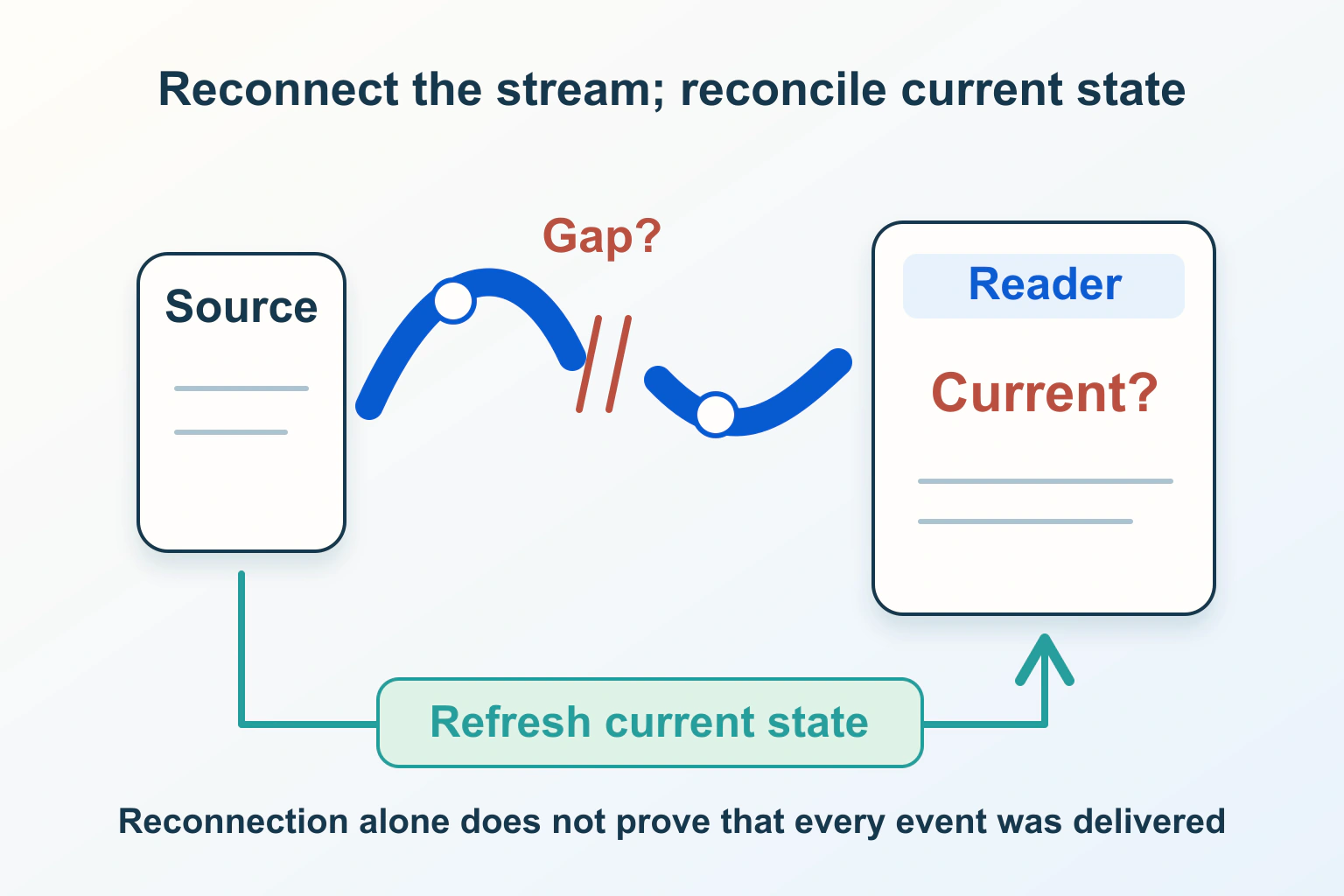
A live website can remain visible while its information becomes stale. An open connection indicator, a received event and a correctly updated record are separate observations. Follow those boundaries before adding repeated reconnection code that may create more connections without recovering missing information.
Imagine a fictional repair workshop whose dashboard receives changes to job status. A staff member leaves the page open, returns later and sees an old collection time. The goal is to recover a trustworthy view of that job, not merely to make a connection badge green again.
Confirm which update mechanism the page uses
Ask the authorized developer whether the page uses server-sent events, periodic requests or another mechanism. This guide concerns EventSource-style event streams. A visual live label is not enough to identify the transport, and a correction for one mechanism may be irrelevant to another.
For the workshop, choose a fictional job in staging and record the expected update, its identifier and the observed time. Compare the dashboard with an authorized current-state view. Avoid using private customer details in screenshots or logs merely to demonstrate that a row is old.
Your website says offline while the internet works: separate network hints from service results addresses an adjacent failure boundary. Keep that investigation distinct from proving that this particular stream delivers the expected events and that the page applies them correctly.
Separate stream bytes from dispatched events
MDN describes text/event-stream messages separated by blank lines. A named event needs a matching listener; the ordinary message handler receives messages without a named event field. Bytes arriving in a response therefore do not alone prove that the intended application handler ran.
In the workshop example, a developer might find a status-update event while the page listens only for ordinary messages. That is a fictional hypothesis to check, not a diagnosis that applies to every stalled dashboard. Review the actual event name, complete framing and handler destination.
Also distinguish a quiet period with no changes from a broken delivery path. Generate one permitted test update with a recognizable fictional value, then follow that value from the producer to the rendered row. A heartbeat is useful evidence of a path, but is not the missing business update.
Understand what reconnection can and cannot recover
The HTML Standard defines EventSource reconnection and last-event-ID behavior. It also specifies HTTP 204 as a way to stop reconnection. Do not assume every closure should be countered by an application loop that immediately opens a fresh stream.
For the workshop, ask whether the service retains events and understands the resume position. If it does not keep history, reconnecting may resume future notifications while leaving the earlier missed change unresolved. A current-state refresh can address a different question from replaying an event sequence.
Keep ownership clear. Does the native object reconnect, or does a wrapper deliberately replace it? Inspect whether old objects are closed when replaced. An accumulation of listeners or streams can produce duplicate updates even when each individual connection looks healthy.
Give event identity an application meaning
MessageEvent exposes lastEventId as a string. That value can help correlate what arrived, but does not by itself prove durable processing, uniqueness across every service or exactly-once application delivery. Define those guarantees in the application’s own design.
Suppose the fictional service uses ordered job-version identifiers. The dashboard could compare an incoming version with the displayed version and request current state when a gap cannot be reconciled. That is a proposed design choice, requiring compatible service behavior, rather than a guarantee supplied by the identifier property.
| Evidence | Question still open | Next useful check |
|---|---|---|
| Connection opens | Are complete useful events arriving? | Trace a fictional update |
| Event bytes arrive | Does the right listener run? | Check framing and event name |
| Stream reconnects | Were missed changes recovered? | Check replay or current state |
| Same update appears twice | Are streams or handlers duplicated? | Review object ownership |
Recover a useful view when history is unavailable
The workshop can tell staff that updates are reconnecting and retain the last confirmed job data with a clear age. Avoid silently presenting an old collection time as current. A visible refresh route is more helpful than an unexplained spinner that obscures the record.
Coordinate a current-state snapshot with the stream so the application does not overwrite a newer event with an older snapshot response. Ask the developer how ordering and versions are handled during recovery. The appropriate algorithm depends on the service contract and data model.
Give the workshop a recovery acceptance example: after returning, job A must show the latest confirmed collection time, while an unresolved job B remains visibly uncertain. This is more informative than requiring every connection indicator to turn green.
Set meaningful website uptime checks and triage alerts without guessing supplies context for uncertain application state. A recovered stream should lead to information staff can act on, with a clear boundary between confirmed details and a view still being reconciled.
Test interruptions and continuation
Propose a staging exercise that changes a fictional job, interrupts the connection, changes it again and restores the page’s connection. Observe whether the final rendered version matches current service state. Keep this controlled; do not interrupt production traffic to demonstrate a tutorial.
Repeat with a named event, a quiet stream, a deliberate server stop and two open dashboard tabs. Record whether the client resumes, stops or refreshes state as intended. Do not infer the result from an open badge alone.
These exercises have not been run against a reader’s dashboard. Fix broken website buttons and blank screens with Console and Network evidence explores another transport-related boundary that may help after evidence identifies it, rather than acting as a universal explanation for every stopped live view.
Document the recovery contract
Keep the stream format, listener names, resume policy and current-state fallback together. Explain the point at which the interface considers itself current and what happens when that point cannot be established.
Reliable live updates mean that a reader can understand and recover the actual information. Reconnection is one mechanism in that journey; it is not proof that every missed change has been safely applied.
Sources and verification
Editorial review 2026-10-15. Source check dates are recorded separately. Notes describe what each source supports and its limits.
View sources
- MDN: Using server-sent eventsChecked text/event-stream uses separated messages and optionally named event listeners.
Limits: Transport examples do not establish application replay guarantees. - WHATWG: Server-sent eventsChecked Defines EventSource, reconnection, last-event-ID and HTTP 204 stopping reconnection.
Limits: Automatic reconnection does not provide durable server history. - MDN: MessageEvent lastEventIdChecked The received message exposes an event-ID string.
Limits: An identifier alone is not a processing acknowledgement.