
Treat an unknown outcome as unknown. Combine understandable client feedback with a reviewed server-side operation and recovery design; never claim that disabling a button, redirecting or retrying alone prevents duplicate processing.
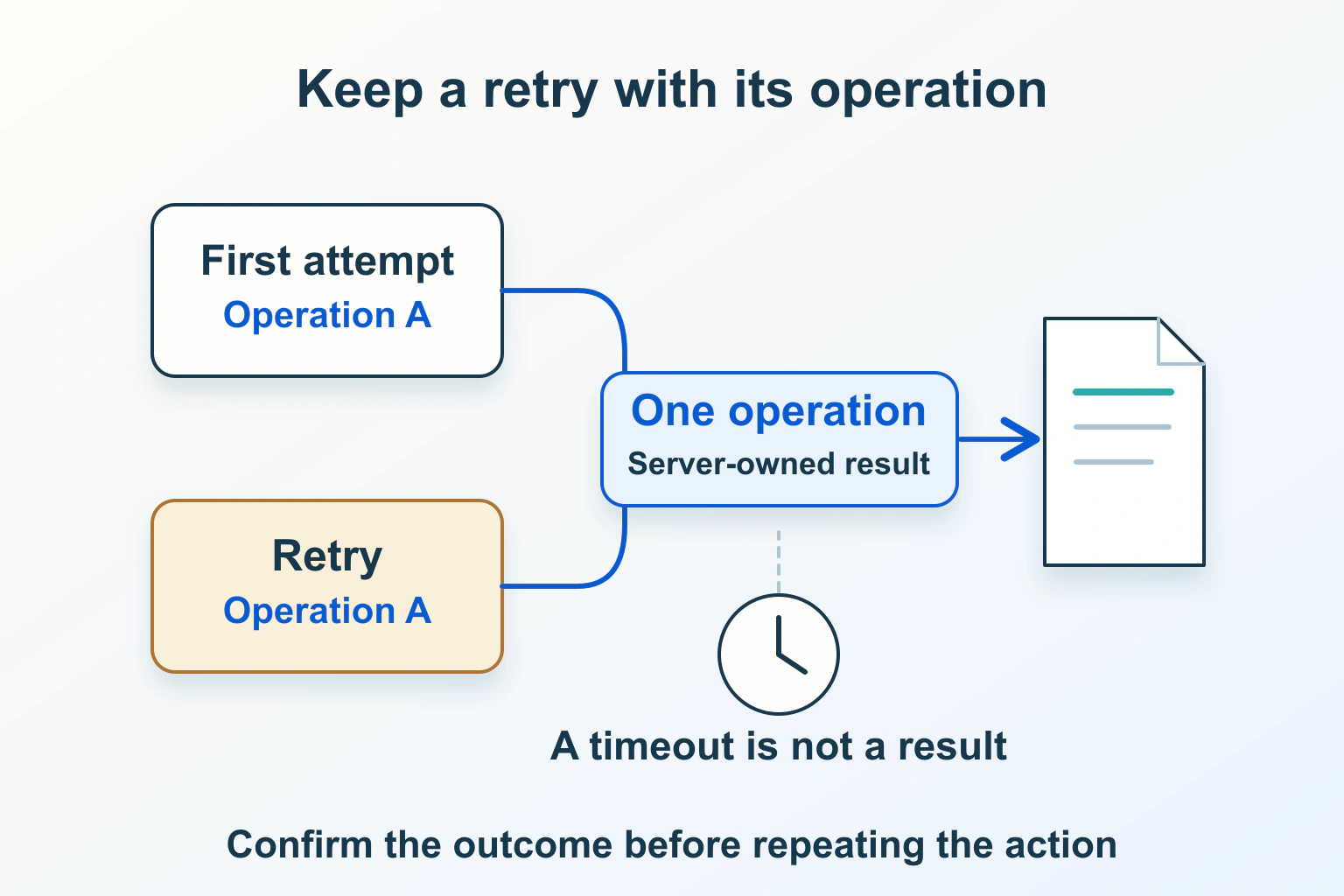
A timeout means the page did not obtain a usable result; it does not prove the server discarded the request. A form can be processed successfully while its response is lost. Repeating that operation blindly can create a second enquiry. Design the final submission, its acknowledgement and its recovery path together.
This guide uses a fictional workshop-enquiry form. Its state model and proposed checks are original architectural examples, not a tested backend recipe. It concerns the final action, separately from saving a draft or moving between steps. Payment and other high-impact operations need their own reviewed integration rules.
Define what acceptance actually means
For the workshop, acceptance means an enquiry record was stored and given a reference. It does not mean a staff member read it, an appointment was reserved or an email notification arrived. Choose this boundary with the person responsible for the process before writing the success message.
Record where that decision is made and what response demonstrates it. A spinner ending, a client-side event firing or a successful connection is not sufficient evidence of the business outcome. Keep response parsing failures distinct from a handler explicitly rejecting the request.
In a multi-step interface, the review page should show the current answers actually being sent. Our draft and resume guide covers the earlier storage promise. An acknowledged draft remains different from an accepted final enquiry.
Give the interface five honest states
| State | Meaning in the fictional form | Appropriate next action |
|---|---|---|
| Ready | The current answers can be reviewed and sent. | Allow deliberate submission. |
| Sending | A final attempt is awaiting a result. | Explain progress and discourage duplicate activation. |
| Confirmed | The handler acknowledged the stored enquiry. | Show its safe reference and truthful next step. |
| Rejected | A known result says the attempt was not accepted. | Explain a correction or supported retry. |
| Unknown | The page cannot establish the final outcome. | Offer the reviewed status or recovery route. |
Unknown is not a decorative replacement for every error. A documented validation rejection can be specific. A connection interruption after sending needs different wording. The visitor should not be told “Nothing was sent” merely because the browser stopped waiting.
Protect the interaction without losing its values
A pending state can prevent repeated local activation and communicate that work is underway. Apply it consistently to pointer clicks, keyboard activation and any supported programmatic submission. Restore an operable state after a known failure; a permanent disabled button creates another problem.
MDN documents disabled controls as not focusable and absent from submitted form values. Do not disable every input before capturing the values the handler requires. A whole-form visual lock can accidentally remove necessary data while still failing to protect the server from another request.
Use the form system’s supported submission path. requestSubmit() follows submit-button behavior, including constraint validation and submission events; direct submit() differs. Neither is a duplicate-processing solution. Review custom Enter-key handlers before adding a second path that sends alongside the native one.
Put duplicate handling at the operation boundary
RFC 9110’s idempotency section concerns intended server effects. It restricts automatic retry of non-idempotent requests unless the client knows repetition is safe or knows the original was not applied. A timeout alone supplies neither conclusion.
The workshop’s implementation therefore needs a reviewed way to recognise another attempt at the same operation. The following requirements are an original design checklist, not a universal header, token format or database recipe:
- Define the operation’s scope, including the relevant form, actor or session boundary and intended action.
- Keep its identity stable across a supported retry of the same action, rather than generate an unrelated identity for every click.
- Associate that identity with the accepted payload and define how conflicting changed answers are handled.
- Make concurrent acceptance safe through the backend’s supported persistence and transaction design.
- Return an appropriate existing result for a recognised repeat, without starting the business action again.
- Define expiry, retention and recovery without exposing another visitor’s private enquiry.
An operation identifier is not permission to view its result. Keep the existing authentication, authorisation, validation and abuse protections. Do not publish private request contents in a status address or put credentials into a client-side deduplication experiment.
Separate retrying from changing the request
Suppose the visitor sends a request for two chairs, loses the response and changes the quantity to three. That is not automatically the same operation with harmlessly different text. Define whether the interface must first resolve the original, submit an explicit amendment or begin a genuinely new request.
Silently accepting the new payload under the old identity can hide the change. Always creating a fresh identity can create two accepted enquiries instead. Explain the supported choice to the visitor and preserve the relationship in the handler’s own process.
For the fictional workshop, the proposed recovery route first checks whether the original enquiry exists through an authorised status mechanism. If it does, the interface offers the documented amendment route. If the outcome remains unknown, it explains how to contact support without claiming a rejected or accepted state.
Use a result page without confusing it with deduplication
RFC 9110 describes 303 See Other for retrieving a separate resource. A result page can make a successful journey easier to revisit. However, redirecting after acceptance does not itself prevent two initial submissions from being processed concurrently.
For the workshop, the confirmation page should show the acknowledged enquiry reference and next step. Refreshing that page should not itself create another enquiry. Keep any private result under the appropriate access controls; a convenient bookmark is not a reason to expose the original message publicly.
Keep notification delivery separate
An enquiry record and its notification are different operations. Staff can receive two notification attempts for one record, or no notification despite the record existing. The success wording and internal investigation should preserve those distinctions.
Agree how the notification integration handles retries and how staff find accepted enquiries when delivery fails. Do not promise exactly-once email delivery because the enquiry record has a duplicate-prevention rule. Our contact-form email diagnosis covers that separate route.
Explain recovery where the visitor needs it
WAI’s notification guidance supports clear success and error feedback with actionable correction. Match the message to the known result, preserve appropriate non-sensitive answers and make the next action reachable. Do not replace a useful explanation with an endless spinner.
Review how the pending and final messages are discovered by keyboard and assistive-technology users. The broader form accessibility guide covers labels and error relationships. Correct semantics cannot make a false “Submitted” message accurate.
Test uncertain outcomes in a controlled environment
Use synthetic enquiries and an authorised test setup. Write expected accepted-record counts before exercising rapid double activation, Enter submission, validation rejection, slow responses and an interrupted response after backend acceptance. Include a deliberate retry, confirmation-page refresh and a second tab.
Inspect the operation records as well as the interface. A single success screen does not prove a single accepted action; two network attempts do not necessarily mean two actions when duplicate handling works. Keep safe references and test outcomes, not private message contents, in review evidence.
Accept the journey when known rejection remains correctable, acknowledged acceptance stays truthful and uncertainty has a supported recovery route. A disabled button is useful feedback; the complete submission lifecycle is what protects the request.
Sources and verification
Editorial review 2026-10-15. Source check dates are recorded separately. Notes describe what each source supports and its limits.
View sources
- RFC 9110: Idempotent methodsChecked Idempotency and retry limits for non-idempotent requests.
Limits: No universal form identifier or exactly-once processing guarantee. - RFC 9110: 303 See OtherChecked Retrieval of a separate resource after an action.
Limits: No deduplication of concurrent initial requests; shares the idempotency section's source budget. - MDN: disabled HTML attributeChecked Disabled controls are not focusable and their values are omitted from form submission.
Limits: A client-side disabled state does not prevent another tab or request from reaching the server. - MDN: HTMLFormElement.requestSubmit()Checked The submit-button-like path includes constraint validation and submission events, unlike direct submit().
Limits: Neither method supplies business-operation deduplication. - W3C WAI: User notifications for formsChecked Useful success and error feedback, identifiable failures and actionable correction.
Limits: An accessible message must still match the operation's actual result.