
Classify the contents and intended audience of exact owned release artifacts; revoke actual exposed secrets and verify distribution rather than relying on removed annotations.
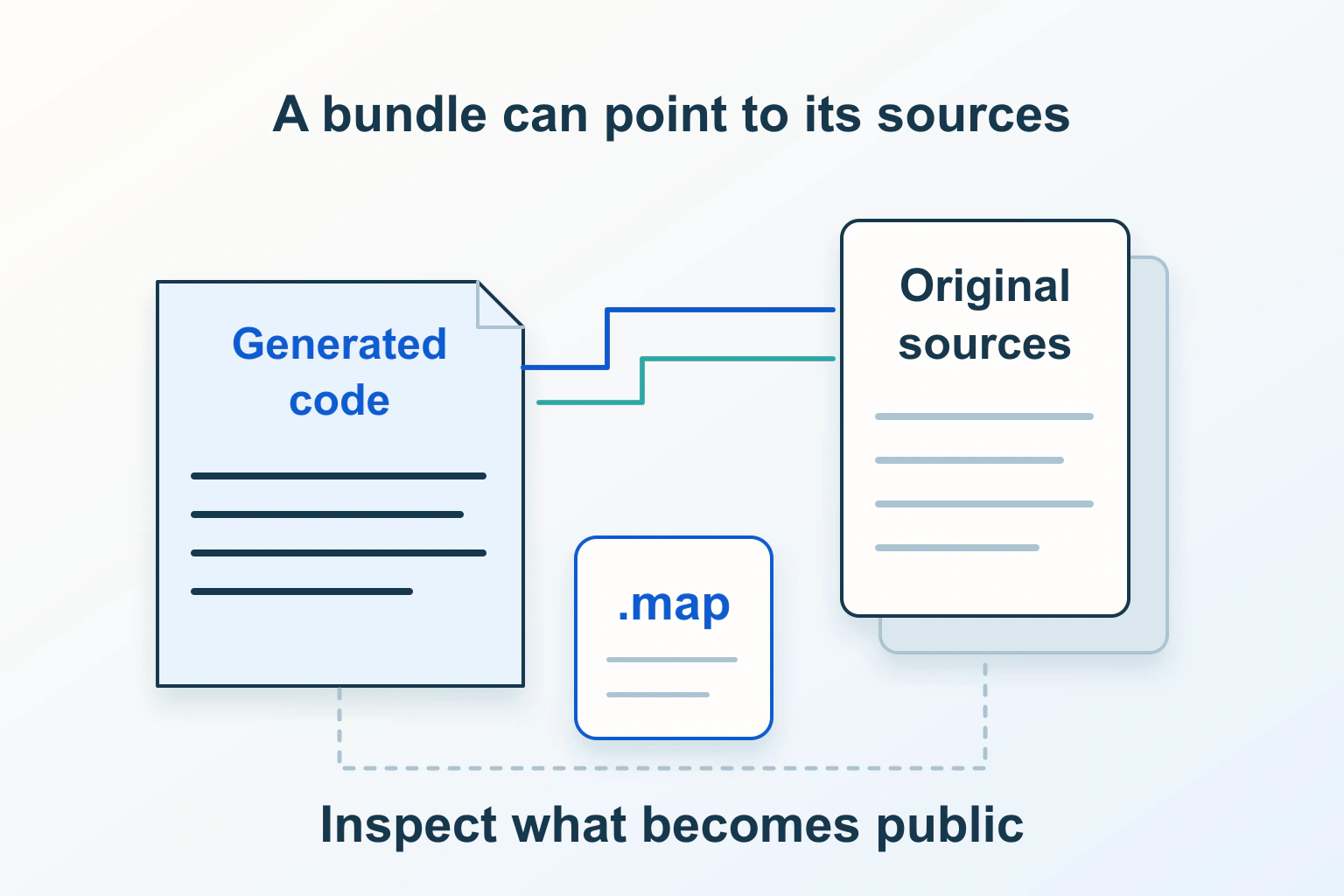
A public source map is not automatically a security incident, but it deserves a release review. Inspect what it contains, who can retrieve it and whether that matches your intended publication policy. If a real secret escaped, revoke or rotate it; deleting the map cannot make an already exposed credential trustworthy again.
This guide is for builds and website assets you own or are authorised to review. Its fictional workshop application illustrates a decision process. It does not provide a way to scan other businesses, test discovered credentials or claim that a particular deployment is safe.
Separate readable source from confidential information
A browser needs the delivered JavaScript to run a frontend application. Removing a map does not make that delivered code confidential. A map can make the relationship to original files easier to understand, and can expose material beyond the compiled output when the build includes it.
The published ECMA-426 standard defines source maps for debugging compiled JavaScript, WebAssembly and CSS. Its optional sourcesContent field can carry original source text. A filename alone is different from an embedded configuration file containing a working credential.
For the fictional workshop, a file named appointment-panel.ts is ordinary implementation detail. A server credential mistakenly copied into an original file is a different finding. Classify actual contents and permissions before labelling every map a leak or dismissing every map as harmless.
Start with the exact release, not a guessed filename
Record the application, environment, deployed release identifier and owned asset locations. Include the public asset host if a CDN serves scripts separately. Keep this inventory private if it contains internal paths; evidence notes should identify the finding without reproducing sensitive values.
Use the release output and deployment manifest to identify map files and inline maps. Include older releases still intentionally served for open tabs or rollback. A review of today’s build directory alone does not establish what yesterday’s public deployment still exposes.
Ask who owns each artifact. A third-party script loaded by your page is not permission to investigate that provider’s infrastructure. For an external component, review your integration and ask the provider about its documented publication policy.
Check every way the resource identifies its map
A JavaScript response can point to a map through its SourceMap response header or a sourceMappingURL annotation. MDN documents that the header takes precedence when both are present. X-SourceMap is deprecated. Read the actual response, not only the source file before deployment.
A build can also embed map data directly in an annotation. Removing a visible comment from one script does not restrict a separately deployed .map URL, nor remove an inline map from an older cached asset. Treat discovery instructions and access policy as separate checks.
For an authorised public-access check, use the exact known URL from your manifest without an administrator session. Record status, expected content and the serving host. Do not probe invented directories or publish a sensitive response in a screenshot. Our Console and Network guide covers the separate task of tracing a broken interaction.
Inspect contents without spreading the exposure
Review a restricted local copy of the matching release. Look at sources, sourceRoot and any embedded source text, along with build configuration and files the map references. A map without embedded source can still reveal useful internal details; that does not establish a working exploit.
CWE-540 describes the weakness of including sensitive information in source code. Use that distinction to identify data whose disclosure matters, rather than treating the presence of readable code as proof of an incident.
- Is a value a private credential, a deliberately publishable identifier or a harmless example?
- Does a comment contain real customer data, a private support record or an internal-only address?
- Was a development configuration included that the frontend never needed?
- Are licensed or confidential source files being distributed contrary to the intended release policy?
Determine a key’s purpose through your provider configuration and documentation. Some identifiers are designed to be public, with server-side authorisation enforcing the sensitive operation. Do not try a suspected live secret to see what it can access. Escalate it privately to the responsible owner.
Choose a debugging policy explicitly
| Policy | What to verify before release |
|---|---|
| Intentionally public maps | The mapped source is approved for publication and contains no inappropriate data. |
| Private debugging maps | Correct release maps reach an authorised debugging system; public deployment excludes them. |
| No retained maps | The team accepts the diagnostic cost and has another workable incident investigation method. |
These are operational choices, not security grades. For the workshop, a private debugging service might be the appropriate destination because staff need readable error locations but the original source is not intended as a public deliverable. The team should document that choice instead of relying on a bundler’s current default.
Private storage needs its own access and retention controls. Review the separate private-response cache boundary if a protected debugging endpoint serves sensitive material. Keep the exact map paired with its compiled asset and release. A map from another version can produce a convincing but wrong source location. Decide who can upload, retrieve and delete it, and how a rollback preserves the matching pair.
Handle an actual exposed secret as a credential incident
Stop republishing the affected value, then follow the service’s supported revocation or rotation process. The OWASP secrets-management guidance covers secret lifecycles, rotation, revocation and auditing. Removing an artifact addresses distribution; replacing the credential addresses continued use.
Review the credential’s permitted operations and available access records through the responsible administrator. Preserve relevant incident evidence privately. Do not conclude that there was no misuse merely because a public request now fails or a search engine cannot find the old file.
Coordinate replacement with dependent services so a hurried fix does not break the live workflow. Use a restricted replacement and remove the reason the build captured it. Changing the string while leaving the same frontend injection path can publish the next credential on the following release.
Verify the deployed result and older reachable artifacts
After a scoped correction, build again and compare the public manifest with the chosen policy. Check exact affected URLs on the public serving path, including the CDN, and confirm that inline content and response headers agree with that policy. Purging one cache does not prove the origin stopped serving the file.
If old assets must remain for compatibility, decide deliberately how their maps are handled. Avoid deleting unrelated release assets that existing visitors need. Maintain a removal inventory so another deployment or rollback cannot quietly restore an excluded map.
In the workshop example, the acceptance record should distinguish three outcomes: the public artifact no longer contains the inappropriate material, the exposed credential is unusable through supported revocation, and authorised staff can still investigate the matching release. One green build badge cannot establish all three.
Make the next release easier to review
Add a small artifact-policy check to the actual build pipeline: inventory produced maps, compare intended public files, review source inclusions and stop unexpected output for investigation. A scanner can help identify suspicious patterns, but it cannot reliably distinguish every publishable identifier from a secret or every confidential comment from ordinary prose.
Keep responsibility clear when a theme, plugin or build-service update changes output. Review the generated package, not only the configuration diff. Record the release and policy decision without copying discovered values into an issue, public repository or support conversation.
Accept the review when distribution matches the documented choice, inappropriate contents are addressed at their source, real secrets have a recorded recovery action, and debugging retains the evidence the team needs. The useful question is what this release publishes and why, rather than whether every .map extension should exist.
Sources and verification
Editorial review 2026-10-14. Source check dates are recorded separately. Notes describe what each source supports and its limits.
View sources
- MDN: SourceMap response headerChecked Map discovery through the response header, its precedence over sourceMappingURL and the deprecated X-SourceMap form.
Limits: A discovery header does not provide authentication or establish the sensitivity of the map contents. - Ecma International: ECMA-426, first editionChecked Published source-map format, debugging purposes and optional original source contents.
Limits: The published first edition is distinct from the linked evolving editor draft; a format specification is not a deployment-security verdict. - MITRE: CWE-540, Inclusion of Sensitive Information in Source CodeChecked Sensitive material in source code is a distinct disclosure weakness.
Limits: A readable source file or internal-looking filename alone does not establish an exploitable vulnerability. - OWASP: Secrets Management Cheat SheetChecked Credential lifecycle, rotation, revocation, restricted access and audit considerations.
Limits: The appropriate recovery procedure depends on the actual provider and credential; deleting a map does not revoke a credential.