
Treat recorded opens as image-load observations, audit decisions that depend on them, and choose deliberately defined outcomes without trying to defeat recipient privacy.
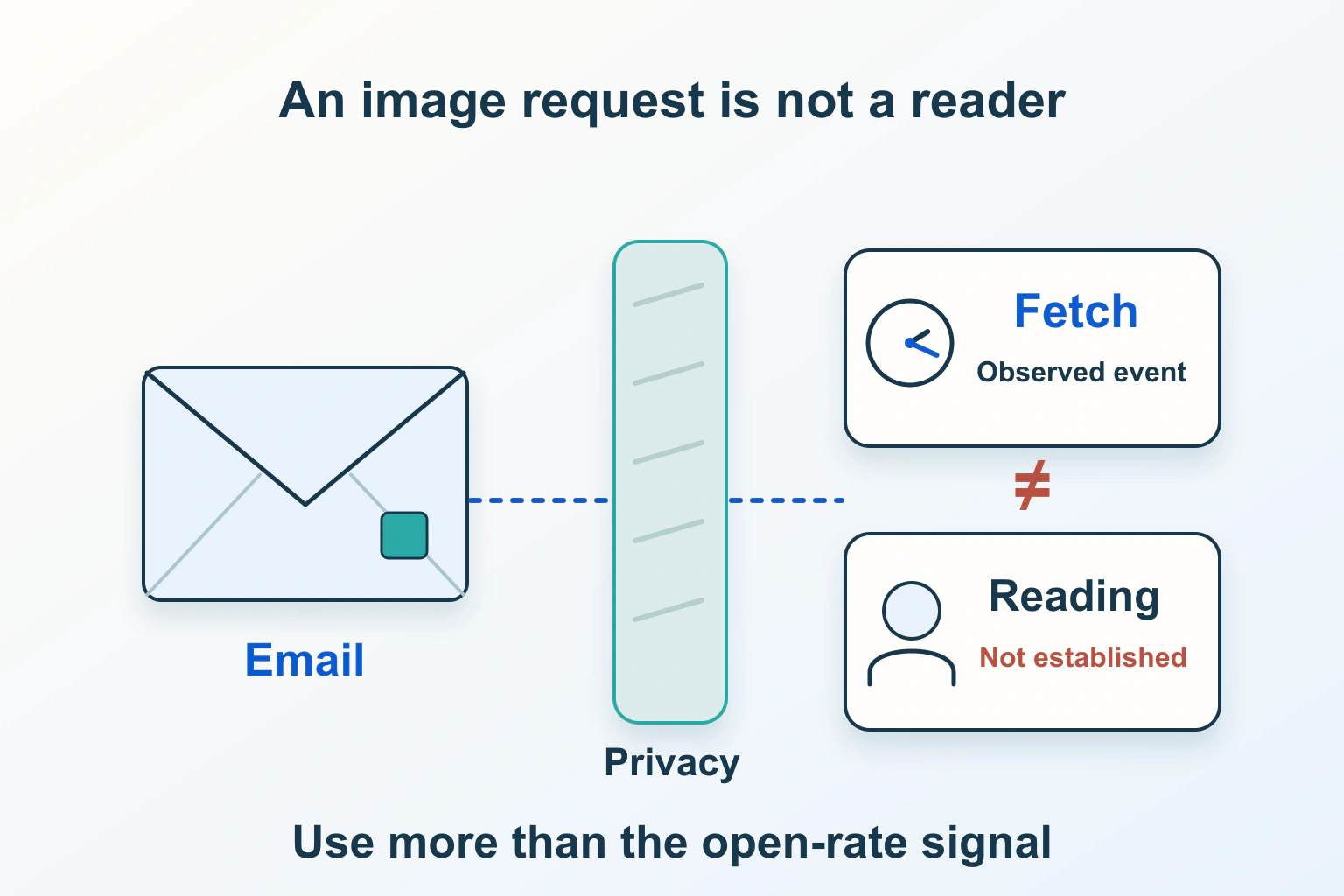
Use newsletter open rates as limited observations, not a reliable list of people who read. Before changing content, inspect any resend, inactivity, scoring or experiment rule that depends on an open. Choose the reader outcome you want and keep its definition beside the report.
A sudden rise in opens can feel encouraging, while a low rate can invite aggressive list cleaning. Neither number explains itself. A fictional design studio’s monthly tutorial newsletter provides the examples below; its figures are invented arithmetic, not campaign benchmarks or Pagember measurements.
Know what an open report actually observed
Many campaign systems observe a tiny remote image being requested. Mailchimp’s explanation of privacy-related opens describes how preloading those images makes open-based reports and downstream features unreliable. A request to display remote content is not direct evidence of attention, comprehension or interest.
Apple’s privacy description says protected remote content can be retrieved in the background even without engagement, with relays separating the recipient’s address from the content destination. It also describes separate settings for Mail on iCloud.com. Do not identify affected readers merely by looking for an iCloud email address.
Nor should every Apple device, mailbox or message be labelled protected. The relevant feature and client configuration matter. The useful operational question is simpler: can the signal support this particular decision when some reading activity remains unknown?
Separate an observation from a business conclusion
Give each reporting field a plain-language meaning. “Recorded unique opens” describes a platform’s observations under its current rules. “People interested in the next workshop” is an interpretation requiring other evidence. Mixing the labels makes a technical change look like a commercial success.
For the studio, opening an issue is not its final objective. The newsletter helps subscribers finish a maintenance task. The team might look at voluntary replies describing the task, visits to its instructions and completed workshop requests. Those measures answer different questions and should remain separate rather than being combined into an unexplained engagement score.
Also retain an unknown state. Someone may read an email without loading its images, or a privacy system may load images without that person reading. Missing evidence is not equivalent to a negative response, and a recorded event does not remove the uncertainty.
Find the sending rules most exposed to error
| Current rule | Possible wrong decision | Better review question |
|---|---|---|
| Resend to everyone who did not open | Repeat a message to readers whose reading was not observed, while missing others. | Does a second issue add useful information, and who is genuinely eligible for it? |
| Remove anyone without opens | Classify an unknown reader as inactive. | What evidence and preference process support a sending restriction? |
| Increase a sales score after an open | Turn a background image request into purchase intent. | Which deliberate action justifies the score? |
| Choose a subject-line winner by opens | Reward a measurement artifact rather than the intended outcome. | What comparable downstream result tests the actual question? |
Record the workflow name, affected audience, current condition and consequence. Review the highest-consequence rules first. A dashboard label can remain imperfect while you remove its authority to trigger a misleading personal sales message.
Do not change the whole automation account at once. Preserve existing settings and queued-message information, make one authorized correction, and inspect its scope before activating it. Changing a trigger is separate from deciding what happens to people already inside a sequence.
Keep permission and engagement as separate records
An open does not grant permission for another newsletter. A missing open does not withdraw permission either. Use the actual subscription and preference records to determine sending eligibility, then use the available evidence to assess relevance within that eligible audience.
If you adopt an inactivity policy, define the period, evidence and resulting action in language a colleague can apply consistently. For example, moving a group out of an optional promotional sequence is different from deleting its subscription history. Preserve valid opt-outs and delivery restrictions through any cleanup or platform move.
Test preference changes independently using the newsletter unsubscribe and preference workflow. A smaller audience is useful only when its membership reflects the intended rules; an impressive open rate obtained by excluding uncertain readers is not proof of healthier relationships.
Do not calculate a fictional true-open rate
Suppose the invented studio campaign has 2,000 delivered messages, 1,000 recorded unique opens and 80 recorded unique clickers. The displayed open rate is 50% on that delivery denominator. The click rate is 4%; clickers divided by recorded openers gives 8%.
If a provider’s filtered view instead reports 500 unique opens for that same campaign, the last ratio becomes 16% without one extra click. That change illustrates denominator sensitivity. It does not establish that exactly 500 people read, that 500 were privacy preloads, or that the content became twice as persuasive.
There is no sound repair in subtracting an assumed device share from the open total. You do not know the unobserved overlap between readers, image loading and classification. Report the available measurement with its limitations rather than presenting a modelled guess as a recovered fact.
Design the next experiment around one answerable question
Write the question before writing the alternative subject lines. “Which wording helps eligible subscribers find the checklist?” has a different outcome from “Which wording generates the most recorded opens?” Decide the comparison window, denominator and result to examine before seeing which variation looks better.
Keep the message and destination otherwise comparable. If one version promotes a free guide and another a paid workshop, the result cannot isolate wording. If the audience is small and the outcomes few, keep the conclusion modest rather than declaring a universal winner from a handful of actions.
Prefer a stable primary measure and keep secondary observations visible. The studio could compare qualified checklist visits across assigned recipients, while separately recording unsubscribes and replies. Consent-dependent website analytics or missing attribution may limit that comparison; describe the gap rather than silently treating unmeasured visits as absent.
Use clicks carefully rather than making them the new truth
Apple’s iPhone guidance distinguishes protection of mail activity from following links or opening attachments. That boundary does not make every tracked click human. Security checks and other automation are a separate measurement problem.
Mailchimp documents bot filtering as identifying most automated interactions, not all. Note the filter state, campaign and reporting interval when comparing results. A change in classification should not be presented as a sudden change in subscriber appetite.
Use the separate guide to security-scanner clicks when click and landing-page totals disagree. For a consequential action, look for the deliberate completed journey rather than promoting an email redirect request into certainty.
Make the reporting handover understandable
Keep a short decision log: campaign objective, eligible audience, report window, delivery denominator, tracking and filtering settings, observed result, uncertainty and the change proposed. An aggregate record is often sufficient; do not distribute recipient-level exports merely to discuss editorial performance.
Accept the revised process when a colleague can explain why a resend occurs, why a subscriber is excluded, what an experiment can establish and which activities remain unknown. Respecting reader privacy does not prevent useful measurement. It requires choosing decisions your evidence can actually support.
Sources and verification
Editorial review 2026-10-15. Source check dates are recorded separately. Notes describe what each source supports and its limits.
View sources
- Apple: Mail Privacy Protection and PrivacyChecked Background retrieval of remote content regardless of engagement, relay-based IP separation, and distinct Mail on iCloud.com settings.
Limits: It does not identify which recipients enabled protection or reconstruct their actual reading. - Apple Support: Use Mail Privacy Protection on iPhoneChecked The feature's privacy purpose and the different treatment of clicked links and attachments.
Limits: An iPhone guide is not a complete inventory of every mail client, privacy service or configuration. - Mailchimp: Apple Mail Privacy Protection FAQsChecked Open tracking pixels, misleading open metrics, and implications for open-dependent experiments and automations.
Limits: Reporting controls and automation behavior are specific to the provider and can change; clicks still need separate automated-activity scrutiny. - Mailchimp: About Bot Activity and Bot FilteringChecked Automated open/click activity, provider filtering and the limitation that filtering identifies most rather than all automated activity.
Limits: A filtered interaction is not a guarantee of a human reader or a complete causal explanation of a campaign.